
304 vs 316 Stainless Steel Camlock Couplings: Which One for Your Line?
Both look identical. Both say “stainless steel” on the box. But 304 and 316 are different alloys with a different job, and picking the wrong one on a chemical or marine line is how couplings pit, corrode and seize.
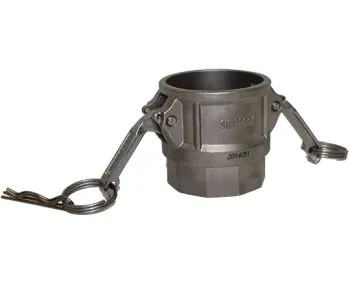
Stainless type D coupler — the grade question (304 vs 316) applies to bodies like this.
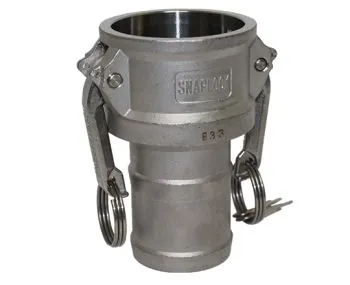
Stainless type C on a hose end — where chloride exposure decides 304 or 316.
The difference in one table
| Property | 304 stainless | 316 stainless |
|---|---|---|
| Chromium | 18% | 16-18% |
| Nickel | 8% | 10-14% |
| Molybdenum | 0% | 2-3% |
| Chloride/salt tolerance | Good | Excellent |
| Acids (sulfuric, phosphoric) | Limited | Better |
| Marine/saltwater duty | Pits over time | Standard choice |
| Magnetic response | Slightly magnetic (cold-worked) | Mostly non-magnetic |
| Typical use | Water, food, general | Chemical, marine, coastal, aggressive washdown |
| Cost premium | — | ~20-40% more |
What the molybdenum does
The 2-3% molybdenum in 316 is the entire story. It stabilizes the alloy against chloride attack — pitting and crevice corrosion from saltwater, brine, bleach and many industrial acids. 304 handles clean water and food lines for decades; put it on a saltwater deck or a bleach CIP line and it pits, starting around gasket grooves and cam-arm pivots where moisture sits.
When 304 is fine
- Clean water, potable water, general transfer
- Food and beverage processing (304 is the food-industry standard)
- Indoor, dry, non-chloride duty
- Cost-sensitive applications where the line will not see salt or aggressive chemicals
When to step up to 316
- Marine and coastal: saltwater contact, or salt air on a dock or ship deck
- Chemical transfer: sulfuric, phosphoric and organic acids, chloride-bearing chemicals
- Bleach / CIP washdown: chlorinated cleaning agents attack 304 quickly
- Pharmaceutical and high-purity: 316 with appropriate finish is the pharma default
- Hot chloride service: temperature multiplies chloride attack
The price question
316 costs roughly 20-40% more than 304 at the same size and type. On a camlock that is a few dollars per unit — the premium buys a coupling that survives a decade on the duty it was chosen for. The expensive mistake is the opposite: saving 30% on 316 and paying for repeated replacement on a chloride line.
Quick rule
Water, food, dry duty → 304. Salt, chemicals, bleach, marine, coastal → 316. If the line can taste salt or see bleach, do not argue with the material choice — specify 316.
Need to confirm the alloy for your line? Send the media, temperature and environment and we will confirm the coupling specification.