
Camlock Couplings for Chemical Transfer: Materials, Gaskets and Safety
Chemical transfer lines are where camlock selection stops being a price exercise. The coupling is a pressure vessel at the end of a hose, and the two parts that decide whether it survives are the body material and the gasket compound.
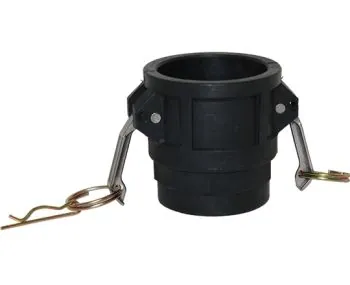
Polypropylene coupler — chemical-resistant plastic body for acid and solvent loading.
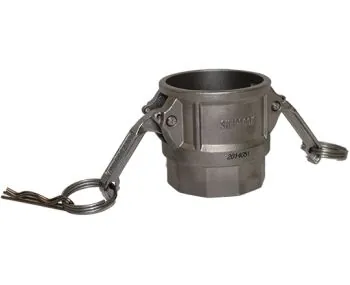
Stainless coupler for aggressive media and higher service temperature.
Body material first
| Media type | Recommended body | Why |
|---|---|---|
| Strong acids, aggressive solvents | Polypropylene or 316 stainless | PP resists most acids/solvents at moderate temperature; 316 SS adds heat and strength |
| Caustics, alkalis | Polypropylene or 316 SS | Aluminum fails fast on caustics |
| General industrial chemicals | 316 stainless | Corrosion resistance with mechanical strength |
| Not recommended | Aluminum (attacked by acids/alkalis), brass (ammonia, some acids) | Galvanic and direct chemical attack |
Temperature matters: polypropylene camlocks are typically rated to about 65-80°C (149-176°F) continuous. Above that, move to stainless steel. Check the specific pressure rating at your service temperature — PP ratings derate as temperature rises.
Gasket compound
- Viton (FKM): the workhorse for chemical lines — broad resistance to acids, solvents and hydrocarbons, rated to ~200°C
- PTFE: nearly universal inertness and the best high-temperature option, but harder; specify an encapsulated or spring-energized design for pressure service
- EPDM: good for some chemicals and hot water, but attacked by hydrocarbons — not a chemical-line default
- NBR: oil and fuel, not general chemicals
When in doubt on a chemical line: 316 stainless body + Viton gasket is the safe default. Polypropylene + Viton covers moderate-temperature acids at lower cost.
Safety rules for chemical loading lines
- Pressure-test the assembly before each connection — a coupling failure on a chemical line is not a nuisance, it is an exposure incident.
- Use dust caps and plugs on open ends. They keep contamination out and residual product in, and they stop foreign objects damaging the sealing face.
- Ground the line for flammable transfer. Camlock couplings are conductive in aluminum/stainless, but polypropylene is not — an ungrounded PP line can build static charge on solvent transfer. Fit a ground strap or use conductive hardware.
- Never mix materials between halves on aggressive media — galvanic corrosion between an aluminum adapter and stainless coupler accelerates in chemical environments.
- Replace gaskets on schedule, not on failure. Chemical exposure hardens compounds even when they look intact.
- Match the thread standard on pipe connections (NPT vs BSPT) — a poor thread seal leaks under chemical pressure before the camlock ever does.
Spec checklist for a chemical camlock line
- Media, concentration and temperature
- Body material (PP for moderate acids/solvents, 316 SS for heat/strength/caustics)
- Gasket compound (Viton default, PTFE for extreme service)
- Size (nominal bore) and type (A-F, DC, DP)
- Thread standard on pipe ends
- Grounding plan for flammable media
- Spare gaskets and dust caps in stock
Send us the media and operating temperature and we will confirm the coupling, gasket and pressure rating for the line — with the figures, not a guess.