
Camlock Couplings for Fire Department Water Supply and Tanker Fill
Walk a fire station bay and you will see camlocks — on dump tanks, pump intakes, wildland water bladders and fill lines. They are the standard quick-connect for the water supply side of fireground operations. One clarification up front: fire hose itself uses storz or NH threads, not camlock. Camlock’s job in fire service is the high-flow supply plumbing — moving water between tankers, dump tanks, pumps and portable bladders.
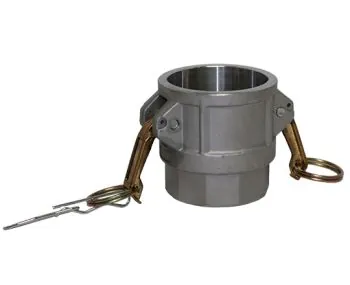
Aluminum coupler — the standard quick-connect on fire water supply hose.
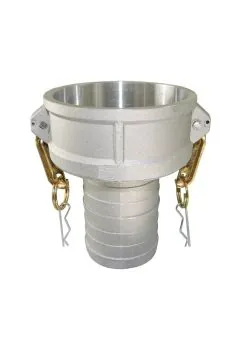
Type C hose shank coupler for delivery-line connections.
The division of labor on the fireground
- Fire hose → storz (European-style bayonet) or NH (national standard thread) — the hose couplings stay on those standards
- Dump tank / portable water tank → camlock on fill and suction ports
- Tanker-to-dump-tank fill → camlock on the discharge and fill lines
- Wildland bladders and drop tanks → camlock on the fill/dump ports
- Pump supply → camlock where the hard suction or supply hose meets the pump intake
Why aluminum dominates fire-service camlocks
- Weight: crews move and connect these in turnout gear; a 4” aluminum coupling weighs a fraction of brass or stainless
- Speed: cam and groove connects in seconds without tools — critical when a tanker is waiting
- Corrosion: aluminum handles clean water, and the occasional muddy fill, better than bare steel
- Cost: departments replace and expand supply plumbing in quantity; aluminum keeps the budget sane
Stainless appears on foam concentrate systems: foam concentrates are aggressive, so PP or stainless bodies with Viton gaskets are the rule on foam plumbing. Plain-water supply stays aluminum + EPDM.
Sizing: fire service is high-flow
Fireground water moves fast — the goal is filling a dump tank or bladder in minutes:
- 3” — standard tanker fill and pump supply lines
- 4” — high-volume tanker fill, large pumpers
- 5”-6” — mass water movement, large dump tanks, wildland supply
Reference pressure note: fire supply is moderate pressure (50-150 psi typical at the pump). Camlocks are rated far above that (2” aluminum ≈ 200 psi working; 4” is lower but still comfortable for supply duty), so sizing is about flow volume, not pressure. Match the coupling to the hose or port bore.
Typical fire-service layouts
- Dump tank fill: Type A (male NPT) on the tanker discharge → Type C (male hose shank) into the fill hose → Type D (female hose shank) on the dump tank port
- Pump intake: Type D on the hard suction or supply hose, mated to the pump intake adapter
- Wildland bladder: Type C or D on the bladder port; a 3” camlock is the common wildland fill standard
- Washdown / station utility: 1”-1½” aluminum for apparatus washdown and station water
Fire-service safety notes
- Verify full arm closure before flow — a half-closed camlock on a 4” fill line is a violent failure waiting to happen; crews check both arms every connection
- Dust caps on open ports — dump tank ports left open collect gravel and grit; a scored groove ruins the seal
- No camlock on foam lines without Viton — foam concentrate destroys EPDM gaskets
- Grounding on fuel transfer — camlocks on tanker fuel connections require bonding/grounding just like any fuel rig
- Inspect gaskets seasonally — UV and ozone age EPDM; a hardened gasket on a supply line leaks under full flow
Checklist for a fire-service order
- Sizes: 3” and 4” (supply/fill), 1”-1½” (utility), 5”-6” (mass water)
- Types: A + C (tanker discharge to hose), D (tank/port connections)
- Material: aluminum (water supply), stainless or PP (foam concentrate), 316 for marine-adjacent stations
- Gasket: EPDM (water), Viton (foam)
- Extras: dust caps and plugs in quantity, spare gaskets, anodized aluminum for permanent station installs
Send us your tanker discharge size, dump tank ports and fill rates and we will confirm the supply coupling set.
Related guides
- Camlock vs storz: why fire hose stays on storz — the coupling standards explained
- Camlock size chart — matching ports and hose bores
- Camlock pressure rating chart — working pressures by size
- Camlock gasket selection — EPDM for water, Viton for foam and chemicals