
Camlock Pressure Rating Chart: What Each Coupling Actually Holds
A camlock coupling’s pressure rating is the one number that decides whether it is safe on your line — and the one buyers most often get wrong. Ratings are not a single figure stamped on the body. They change with size, material, gasket compound, fluid temperature, and even with the way your pump starts and stops. A 2” metal coupling that holds 250 psi will not hold 250 psi at 6”. The same coupling rated at ambient temperature may need a steep derating the moment hot liquid flows through it. And the wrong gasket can turn a sound coupling into a leak — or a failure — long before the metal body reaches its limit.
This guide gives you the working pressure ratings for standard camlock couplings by material and size, explains the engineering behind the numbers, and covers every condition that forces a derating: temperature, gasket material, surge and water hammer, and vacuum service. You will also find a practical method for determining your system’s real working pressure, how hydrostatic testing is done properly, what typical applications actually run at, and the standards behind the ratings.
All figures here refer to standard-profile cam-and-groove couplings made to A-A-59326 geometry, fitted with new, correctly seated gaskets, and tested with water at ambient temperature. Before you trade one alloy for another, review the material guide — and confirm your size designation in the size chart.
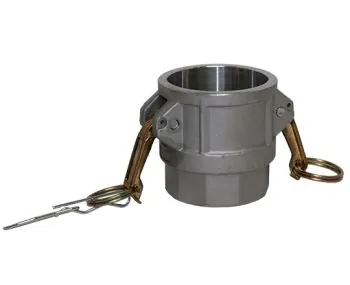
Working pressure comes from size and gasket condition on couplers like this.
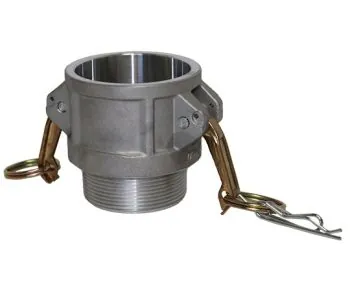
Threaded types — the NPT/BSPT end often sets the pressure ceiling.
Standard Working Pressure by Material and Size
The table below lists standard working pressures for the four most common camlock body materials across the full size range. These are the figures most manufacturers publish for standard-profile couplings in new condition at ambient temperature (roughly 20–23 °C / 68–73 °F), with a standard nitrile gasket correctly seated.
| Size | Aluminum | Brass | Stainless Steel 316 | Polypropylene |
|---|---|---|---|---|
| 1/2” | 150 psi | 150 psi | 150 psi | 75 psi |
| 3/4” – 2” | 250 psi | 250 psi | 250 psi | 100 psi |
| 2-1/2” | 150 psi | 150 psi | 225 psi | — |
| 3” | 125 psi | 125 psi | 200 psi | 50 psi |
| 4” | 100 psi | 100 psi | 100 psi | — |
| 5” – 6” | 75 psi | 75 psi | 100 psi | — |
Notes on reading the table:
- Working pressure means the maximum continuous operating pressure for a coupling in good condition — it is not burst pressure and not a test pressure. All three are different numbers, covered in the safety-factor section below.
- The ratings assume ambient temperature and a new, correctly seated gasket. Both assumptions fail in real service more often than buyers expect, and both are addressed in their own sections below.
- Polypropylene availability: PP camlocks are commonly offered through 3” in the standard catalog, which is why the 2-1/2” and 4”–6” cells are empty. If you genuinely need a thermoplastic coupling at 4” or larger, confirm availability rather than assuming the size exists.
- Stainless 316 vs 304: the table shows 316. Some suppliers rate 304 bodies slightly lower at the larger sizes; always use the data-sheet value for the exact grade you are buying.
- Brass tracks aluminum in the standard catalog; where both are offered at the same size, the numbers match.
- These are reference values for selection. The final authority is the product data sheet for your exact size, material, gasket and temperature combination.
One more thing the table does not say: ratings can differ between manufacturers even for identical-looking couplings. The profile is standardized (more on that under standards below), but wall thickness, alloy quality and casting process are engineering decisions, and they show up in the rating. When a price looks too good for a 250 psi coupling, check the data sheet before you check the price tag.
Why Pressure Ratings Drop as Size Increases
New buyers often assume the biggest coupling is the strongest. It is the opposite: for a given material, the working pressure falls as the bore grows. The reason is straightforward physics, and it is worth understanding because it explains the whole chart.
A camlock holds pressure by clamping the two halves together. The cam arms and the groove they engage carry that load. The separating force the internal pressure creates is the pressure times the area it acts on. Double the bore diameter and the area grows four times, because area scales with the square of the radius. A 4” coupling has four times the bore area of a 2” coupling, so at the same pressure it must resist four times the separating force with essentially the same cam-arm geometry. A 6” bore has nine times the area of a 2” bore — same pressure, nine times the force pushing the halves apart.
The body itself behaves like a thin pressure vessel. For a cylinder of a given wall thickness, the hoop stress from internal pressure is proportional to the diameter: a 6” body with the same wall as a 2” body carries three times the stress at the same pressure. Larger castings also bring larger casting tolerances, more wall-thickness variation, and bigger potential for porosity or inclusions — all of which push manufacturers to rate large bores conservatively.
The gasket adds a third reason. A larger bore means a larger gasket diameter and a longer unsupported span of gasket between the coupling halves. At high pressure, that span is more likely to be squeezed or extruded into the coupling gap, which is why the largest sizes in every material land at or near the 75–100 psi zone regardless of how strong the body is.
Notice that the drop is not a smooth curve. The 2-1/2” and 3” stainless 316 figures — 225 psi and 200 psi — sit well above the aluminum and brass numbers at the same sizes. Same geometry, stronger body wall and stiffer material: the material curve and the size curve are independent, and the table is their product. The 2-1/2” step down to 150 psi in aluminum and brass is similarly a design step, not a typo — the transition from the 2” bore to the larger casting changes the cam-arm geometry and the wall sections, and manufacturers rate that step conservatively.
The practical takeaway: never extrapolate a rating from a smaller size. “It’s the same material, so it must hold the same pressure” is exactly the reasoning that fails. The only safe number is the published rating for your exact size and material.
Temperature Derating: What Heat Does to the Rating
Every rating in the table above is an ambient-temperature number. Heat erodes it in two independent ways: it weakens the body material, and — usually earlier — it degrades the elastomer gasket. When both are in play, the effective rating is the lower of the two.
The gasket is almost always the first limit. Standard nitrile (NBR) gaskets are rated for continuous service up to roughly 100 °C (212 °F) in most fluids, with performance falling off well before that in hot water and steam. EPDM extends the range to about 150 °C (302 °F) and is the usual choice for hot water. Fluorocarbon (FKM) gaskets reach higher still. Above its continuous limit, an elastomer hardens, cracks or loses its compression set: the gasket stops springing back, the sealing force disappears, and the coupling weeps or blows out even though the metal body is perfectly sound. The practical rule — if your fluid is above about 80 °C (176 °F), the gasket, not the body, sets your real rating, and an EPDM or FKM gasket is required, not optional.
Polypropylene has a well-known red line. PP camlocks are rated at ambient temperature, and PP is a thermoplastic: it softens progressively as it warms and creeps under sustained load. 158 °F (70 °C) is the practical red line for PP couplings. At or below that temperature the plastic still behaves acceptably for low-pressure transfer work; above 158 °F the working pressure must be derated by an additional 40% — and many operators treat 158 °F as the ceiling for any continuous PP service, because creep accelerates quickly beyond it. Hot fluids above 158 °F belong on a metal coupling, full stop.
Aluminum and brass derate more slowly. A widely used rule of thumb: full rating to roughly 80 °C, then about 0.5% per °C of additional temperature. At 120 °C that is a 20% reduction; at 150 °C it is 35%. Stainless steel holds its rating far longer — in practice the gasket fails before the body does, so stainless with an EPDM or FKM gasket is the standard answer for hot lines.
One more trap: measure the temperature at the coupling, not at the tank. Solar-heated hoses lying in the sun, pump recirculation, and exothermic reactions all raise the fluid temperature between the tank and the connection point. A “cold” chemical line with a pump running all day can easily be 30–50 °F hotter at the coupling than the storage tank suggests — and that is exactly where the PP red line gets crossed without anyone noticing.
How the Gasket Affects the Pressure Rating
The body gets the headline rating, but the gasket is the part that actually seals — and it can lower the usable pressure of the whole assembly. The table assumes a standard elastomer gasket, nitrile (NBR) in the default specification, new and correctly seated. Change any of those assumptions and the effective rating changes with it.
- NBR (nitrile): the standard compound and the rating basis for the table. Good compatibility with oils, fuels and general industrial fluids; the default choice unless the fluid says otherwise.
- EPDM: the same rating basis in the sizes where it is offered. Better resistance to hot water, steam, weather and many acids; the standard choice for water and food service. In most standard catalogs, EPDM carries the same pressure rating as NBR.
- Fluorocarbon (FKM): the high-temperature, aggressive-chemical compound. Ratings are generally in line with, or modestly below, the standard elastomer figures.
- PTFE (envelope or solid): this is where the rating genuinely changes. PTFE does not behave like rubber. It has almost no elastic recovery, so it seals by being crushed in compression — and it cold-flows, or creeps, under sustained load. Over hours and days the sealing force relaxes, and at higher pressures the PTFE can extrude into the coupling gap. The practical consequence is a derating that can reach 25–40% in sustained service, and PTFE-gasketed couplings are typically reserved for lower pressures and gentler duty cycles. Always confirm the published figure for the specific gasket design rather than assuming the body rating still applies.
Worn gaskets derate themselves. A gasket that has flattened, cracked, swollen or picked up debris is no longer the gasket the rating assumed — and neither is the coupling that carries it. Field rule: replace the gasket at the first sign of hardening, cracking or permanent flattening, and inspect both halves before every connection. Dented grooves and bent cams reduce the effective rating too, because they change the geometry the seal was designed around.
Choose gaskets by fluid compatibility, not habit. The gasket selection guide walks through compound selection in detail; the pressure table above assumes the right gasket is fitted.
Safety Factor, Burst Pressure and Surge
Working pressure is not burst pressure. The figures in the table are the maximum continuous operating pressure for a coupling in good condition. Standard metal camlock bodies are designed with a burst-to-working margin on the order of 3:1 to 4:1 — a coupling rated at 250 psi is expected to burst somewhere in the 750–1000 psi range. That margin is exactly why you must never use it. Operating above the working rating, even briefly, consumes the safety margin, fatigues the cams and the gasket, and turns a controlled system into a projectile hazard.
The most common way systems exceed their steady rating is surge. Surge pressure — water hammer — is a pressure spike generated whenever flow velocity changes suddenly: a pump starting or stopping, a valve slamming shut, a quick coupler snapped closed on a moving column of liquid, or a tank-truck discharge valve opened fast. A sudden valve closure can momentarily double the static pressure in the line, and pump-start transients routinely overshoot the operating point by 20–50% before settling.
The classic failure sequence is easy to miss. The system runs at 180 psi all day, comfortably under the 250 psi rating — and then a pump kicks in and the spike hits 320 psi. No alarm, no burst, just a gasket that starts weeping a week later, or a cam that no longer snaps square. The damage is cumulative, and the coupling that survives a hundred small spikes may fail on the hundred-and-first.
Engineers handle this with margin. A common practice is to size the coupling so the worst-case surge — not the steady pressure — stays at or below the working rating, and to keep a 3:1 margin between the worst-case spike and the expected burst pressure. If your pump starts hard, your valves close fast, or your line is long enough to store kinetic energy, add a pressure-relief valve, slow the valve action, or step up one size or material grade.
Surge is why the “briefly over is fine” mentality fails. Camlocks must never be run above rated working pressure, even momentarily.
How to Determine Your System’s Working Pressure
You cannot pick a coupling from the table until you know the number your system actually generates. The rating you need is the highest pressure the coupling can ever see — not the pressure at your pump’s normal operating point. Work through these steps:
- Find the maximum steady pressure at the coupling location. If the coupling sits at the pump discharge, use the pump’s shut-off head (the pressure at zero flow), which is typically 20–50% higher than the duty point. Convert head to pressure: every 2.31 feet of water column equals about 1 psi. Add the static head from elevation changes and the friction losses of the piping between the pump and the coupling.
- Add a surge allowance. If the system has fast valves, hard-starting pumps or long runs, add 20–50% for transient spikes — or measure the actual spike with a pressure gauge and recorder and use the measured number.
- Apply the temperature derating for the fluid at the coupling, and confirm the gasket compound suits the fluid (see the sections above).
- Check for vacuum. Camlocks are not vacuum-rated by default. Light vacuum under about 10” Hg is usually tolerable with a fresh gasket; deeper vacuum needs a clamped or flanged connection.
- Choose a size and material whose rating is at or above the worst-case number, with the surge margin already included.
Worked example: a small transfer rig moves water with a centrifugal pump that develops 60 psi at the duty flow and 85 psi at shut-off, feeding a line with fast manual valves. Worst case is about 85 psi steady, plus a 30% surge allowance, giving roughly 110 psi. At ambient temperature with an NBR gasket, a 3” aluminum coupling at 125 psi covers it with margin — but a 3” polypropylene coupling at 50 psi does not, no matter how attractive the price.
When in doubt, go up a size or a material grade. The coupling is the cheapest component in the line to upgrade; the pipe, the pump and the downtime are not.
Hydrostatic Pressure Testing: The Right Way
If you need proof that an assembly holds pressure, the only accepted method for camlock fittings is hydrostatic testing with water — and the prohibition on gas testing is absolute.
The standard hydrostatic procedure:
- Assemble the coupling with a new, correctly seated gasket and connect it to the test rig.
- Fill the assembly completely with water and vent every air pocket. Air bubbles are the one thing that turns a water test into a pneumatic one.
- Pressurize gradually with a hand or power test pump to 1.5 times the rated working pressure — the commonly specified proof factor for these fittings.
- Hold the pressure for at least 30 seconds (longer for large assemblies, typically up to a few minutes) and inspect every joint, gasket face and cam for weeping, droplets or permanent deformation.
- Depressurize slowly and drain.
Never test with compressed air or any gas. A pneumatic test stores enormous energy: a 6” line at 100 psi of air holds enough stored energy to launch fittings and hoses as projectiles, and a gas failure is an explosion, not a leak. A water failure at the same pressure is a harmless spray. This is why most industrial safety programs — and most insurers — prohibit pneumatic testing of quick couplings outright. The same logic applies to compressed-air operation: camlocks are not rated for gas service, and they must never carry compressed air, steam or any other compressible fluid.
Two cautions for field work. First, do not field-test a bare coupling above its rating “to see what it takes” — the burst margin is the only thing between you and the failure. Second, recognize that a passed hydrostatic test certifies the assembly at that moment only: it does not forgive a degraded gasket, a bent cam or a dented groove discovered next month. Inspect before every use, and retest after any overhaul, impact or prolonged service.
Typical Working Pressures by Application
The table above covers the possible; most real systems run well inside it. Knowing what your application typically demands makes selection quick and flags the unusual cases where the rating actually bites.
- Irrigation — 30 to 100 psi. Drip and micro-irrigation run at 10–40 psi, impact and rotary sprinklers at 40–80 psi, and mainline laterals up to about 100 psi. Aluminum camlocks at 2”–3” are the classic fit, and every aluminum rating in the table clears these numbers with margin. Polypropylene is acceptable for low-pressure drip headers at 1/2”–2” (75–100 psi).
- Chemical transfer — 50 to 150 psi. Drum and tote transfer, dosing lines and tanker offloading usually sit between 50 and 150 psi, but the pressure is rarely the hard constraint — the chemistry is. Concentrated acids, solvents and oxidizers force the material choice (polypropylene or stainless 316, with the matching gasket compound), and once the material is fixed, its rating at your size usually clears the duty. Always derate PP for warm chemicals; many chemical transfer fluids arrive heated.
- Fuel transfer — 50 to 150 psi. Diesel, gasoline and lubricant transfer from tankers, day tanks and fuel farms typically runs 50–150 psi at the coupling, well inside the aluminum and brass ratings with NBR gaskets. Two operational notes: keep the coupling grounded against static build-up during high-flow fuel transfer, and never use EPDM gaskets in aromatic-fuel service — the gasket swells and fails. NBR or fluorocarbon is correct.
- Fire water supply — high flow, moderate pressure. Fire department connections and hydrant-supplied lines commonly see 40–100 psi static pressure, with surge spikes that can reach 150 psi or more when valves are cracked open fast. Stainless 316 at 4”–6” (100 psi) is the standard choice for suction hose and drafting connections precisely because it keeps a useful rating at the large bores fire work demands, and the 100 psi figure covers the surge cases typical of hydrant supply.
- Dewatering and construction — 50 to 100 psi. Sump pumps, trash pumps and site dewatering run low pressures at moderate flows; aluminum at 3”–4” is the workhorse.
- Potable water and food — 60 to 120 psi. Brass or stainless 316 with food-grade gaskets (EPDM for water and food products); the ratings above apply, with the gasket compound selected for the product.
The pattern: metal camlocks clear almost every non-hydraulic duty at 2” and under; the interesting engineering starts at 4”–6”, where the rating drops and the application pressure and the coupling rating get close enough that the table matters.
Standards Behind the Ratings: A-A-59326, MIL-C-27487 and EN 14420-7
Three documents dominate the camlock world, and knowing what they do — and do not — do prevents expensive mistakes.
A-A-59326 is the Commercial Item Description that defines the modern standard-profile cam-and-groove coupling. It supersedes the military specification MIL-C-27487, which remains widely referenced in procurement documents and legacy drawings. A-A-59326 fixes the critical geometry: the cam arm profile, the groove dimensions, the gasket seat and the overall envelope, so that any A-A-59326 male half mates and locks with any A-A-59326 female half regardless of manufacturer. That interchangeability is the entire point of the standard — it is why a coupling bought in one country mates with a hose end bought in another.
EN 14420-7 is the European counterpart, part of the EN 14420 series for hose fittings. It covers hose fittings with cam locking arms and specifies the profile, dimensions, materials and test requirements for the European market. Couplings built to EN 14420-7 meet the same profile geometry as A-A-59326 products, so cross-standard mating is normal in practice.
What the standards do not do is unify pressure ratings. A-A-59326 and EN 14420-7 define the shape and the interchangeability, plus the test methods — but the working pressure of a given coupling is a manufacturer’s engineering decision, driven by wall thickness, alloy, casting quality and gasket specification. Two couplings from different suppliers, both fully standard-profile and both stamped with the same size, can carry different pressure ratings. The profile guarantees the fit; the data sheet guarantees the pressure. This is also why the “identical to” shortcut is dangerous: an interchangeable profile is not an interchangeable rating.
When you specify, cite both: the profile standard (A-A-59326 or EN 14420-7) for the geometry, and the manufacturer’s published working pressure for the rating.
FAQ
What is the maximum working pressure of a camlock coupling? For standard couplings, 250 psi is the practical ceiling, and it applies only to metal bodies in the 3/4” to 2” range — aluminum, brass and stainless 316 all top out at 250 psi there. Every other size holds less: 150 psi at 1/2” and 2-1/2” in aluminum and brass, down to 75 psi at 5”–6”. Polypropylene peaks at 100 psi in the 3/4”–2” range. If your system needs more than 250 psi, camlocks are the wrong fitting — step up to flanged, threaded or a hydraulic connection.
Can a camlock handle 300 psi? Not a standard-profile coupling. There is no size or material in the standard catalog that is rated to 300 psi, and there is no headroom in the 250 psi figure to “borrow” — the burst margin exists to be preserved, not spent. A system that genuinely operates at 300 psi needs a different connection type.
Why does a 6” coupling hold less than a 2” one? Because the bore area grows with the square of the diameter while the clamping hardware does not grow with it. A 6” bore has nine times the area of a 2” bore, so at the same pressure it produces nine times the separating force the cams must resist. The wall stress of the body scales with diameter too. Same material, same design intent — bigger bore, lower rating.
Does the gasket change the pressure rating? Yes, in both directions. The table assumes a new, correctly seated standard elastomer gasket. A degraded or wrong-compound gasket can fail far below the body rating. A PTFE gasket — chosen for chemical compatibility — typically forces a derating of 25% or more in sustained service, because PTFE creeps instead of rebounding. Always match the gasket to the fluid, not to the habit. See the gasket selection guide.
Can I use camlocks for compressed air? No. Camlocks are not rated for gas service, and compressed air in particular is dangerous: the stored energy of a gas failure turns fittings into projectiles. Use a purpose-built air coupling. The same prohibition covers steam.
How do I pressure-test a camlock assembly? Hydrostatic testing only, with water, and never with gas. Fill the assembly completely, vent all air, pressurize gradually to 1.5 times the working rating, hold, and inspect for weeping or deformation. Never field-test above the rating “to see what it takes.”
Do all manufacturers rate their camlocks the same? The profile is standardized (A-A-59326 / EN 14420-7), and the profile guarantees fit — but working pressure is a manufacturer’s engineering decision. Ratings for the same size and material can differ between suppliers, so the data sheet for your exact product is the only authority.
What temperature can a polypropylene camlock take? 158 °F (70 °C) is the practical red line. Below it, PP is fine for low-pressure transfer work; above it, the rating must be derated by an additional 40%, and continuous hot service above 158 °F belongs on a metal coupling.
Choose the Right Coupling for Your Pressure
Ratings are the boring part of buying camlocks — and the part that prevents the interesting failures. Match the material to the fluid and temperature, match the gasket to both, keep the surge margin, and never run above the published working pressure, and the coupling is the last thing on your line to worry about.
Related guides:
- Camlock coupling types — which configuration fits which end of the line
- Camlock size chart — sizes, bores and part numbering
- Camlock material guide — alloy and plastic selection
- Camlock gasket selection — compounds and compatibility
Need a rating confirmed for your exact combination? Send the size, material, fluid, temperature and worst-case pressure — we will confirm the right coupling before you order.
Ratings are reference values from public industry sources and standard specification practice, pending factory verification. Always confirm against the product data sheet for your exact size, material and gasket combination.