
Camlock Coupling Types: A Complete Guide to A, B, C, D, E, F, DC and DP
Cam and groove couplings look identical at a glance — until you order the wrong letter. Type A through DP aren’t sizes or materials; each letter defines what’s on the non-cam end of the fitting. This guide breaks down every standard camlock type, what it connects to, and how to order the right one the first time.
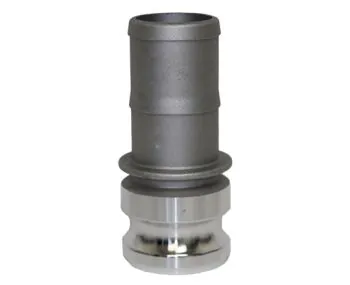
Type E male adapter — one of the eight letter profiles covered below.
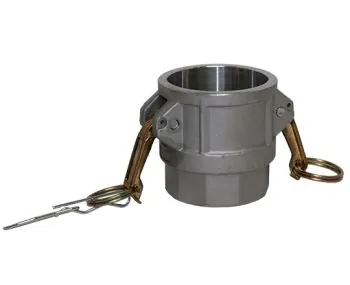
Type D female coupler — the socket half every type letter pairs against.
What Is a Camlock Coupling?
A camlock coupling is a two-part, tool-free quick-connect fitting for hoses and pipes. It’s also called a cam and groove coupling, a cam lock fitting, or a Kamlok-style coupling. One half is the male adapter (the grooved plug), the other is the female coupler (the socket with two pivoting cam arms). Push the adapter into the coupler and close both arms: the cams catch the groove and pull the halves together, compressing the gasket into a leak-proof seal. The whole connection takes about three seconds.
No threads, no tools, no cross-threading risk. That’s why camlocks are the most widely used quick-disconnect coupling in the world for agriculture, chemical transfer, fuel delivery, dewatering, food processing and marine applications.
How the connection actually seals
Understanding the seal mechanism explains most camlock troubleshooting. The female coupler’s bore contains a gasket — typically a flat elastomeric ring seated in a groove. When you insert the male adapter and close the arms, the cam lobes rotate over the adapter’s groove and draw the two faces together. The gasket compresses between the adapter shoulder and the coupler body, and that compression, not the cams themselves, is what stops leakage. The cams only supply the clamping force; the gasket does the sealing. Three practical consequences:
- A damaged or missing gasket leaks even with both arms fully closed — the most common “my camlock leaks” diagnosis.
- The gasket must be compatible with the fluid — NBR for fuel and oil, EPDM for water and most acids, Viton for solvents and high temperatures, PTFE for maximum chemical inertness.
- A dirty groove or a scored adapter face breaks the seal — which is why dust caps and plugs matter more than most buyers expect.
The three-second connection, step by step
- Open both cam arms fully — the coupler is ready to receive the adapter.
- Insert the male adapter until it seats against the gasket; the groove aligns with the cam lobes.
- Close both arms down — each lobe catches the groove and tightens as it snaps past center. Both arms must be fully closed; a half-closed arm can blow off under pressure.
Disconnection is the reverse: open both arms, withdraw the adapter, and cap the open ends. No tools, no rotation, no thread engagement — that speed is why camlocks outnumber threaded couplings on transfer rigs everywhere.
How the Type System Works
Every camlock type is a combination of two ends:
- The cam end — male (adapter: A, E, F, DP) or female (coupler: B, C, D, DC). Any male type mates with any female type of the same nominal size.
- The connection end — male NPT thread, female NPT thread, hose shank (barb), or closed end.
The letter tells you both. Once that clicks, the system stops being confusing. A useful memory aid: the letters follow the alphabet from “threaded on the equipment side” (A, B) through “hose side” (C, E) and “pipe/tank side” (D, F), with DC/DP reserved for the protective pair.
Camlock Coupling Types Chart
| Type | Cam End | Connection End | Typical Use |
|---|---|---|---|
| Type A | Male adapter | Female NPT thread | Screws onto a male-threaded pump outlet or pipe nipple, presents a male cam end |
| Type B | Female coupler | Male NPT thread | Screws into a female-threaded equipment port, presents a female cam socket |
| Type C | Female coupler | Hose shank (barb) | Clamps onto flexible hose — the most common hose-end coupler |
| Type D | Female coupler | Female NPT thread | Screws onto male-threaded pipe or tank outlet, presents a female cam socket |
| Type E | Male adapter | Hose shank (barb) | Clamps onto flexible hose — the most common hose-end adapter |
| Type F | Male adapter | Male NPT thread | Screws into female-threaded ports — the rarest of the six |
| Type DC | Female coupler | Closed end | Dust cap: fits over a male adapter to keep it clean |
| Type DP | Male adapter | Closed end | Dust plug: fits into a female coupler to keep it clean |
Thread standards: NPT is standard in North America; BSPT is common in UK/Europe/Asia. Always confirm thread type with your supplier — a 2” NPT camlock and a 2” BSPT camlock are not interchangeable.
Every Type in Detail
Type A — the workhorse adapter
Type A is a male cam adapter with a female NPT thread on the back. It screws onto a male-threaded pump outlet, pipe nipple, valve outlet or hose fitting, and presents the male cam end for a coupler to snap over. It is the most commonly ordered camlock type in the industry: the classic pump-to-hose layout is a Type A on the pump outlet and a Type C on the hose.
- Sizes: ½” through 6” (8” and larger exist in heavy industrial ranges)
- Materials: aluminum, stainless 304/316, brass, polypropylene
- Common thread backs: NPT (North America), BSPT (UK/Europe/Asia), NPSM
- Typical layout: pump discharge → Type A → Type C on hose → delivery point
The most frequent order error with Type A is confusing it with Type D. Both have female NPT backs; the difference is the cam end — A is male (adapter), D is female (coupler). A and D do not mate with each other.
Type B — the female-threaded coupler
Type B is a female cam coupler with a male NPT thread on the back. It screws into a female-threaded equipment port — pump intakes, tank flanges, filter housings, process vessels — and presents a female cam socket for an adapter (Type E, typically) to snap into.
- Sizes: ½” through 6”
- Materials: aluminum, stainless, brass, polypropylene
- Typical layout: equipment port → Type B → Type E on hose → transfer line
Type B is the port-side counterpart of Type E on hoses: the pair (B + E) is standard for equipment-to-hose connections where the equipment port is female-threaded.
Type C — the hose-end coupler
Type C is a female cam coupler with a hose shank (barb) on the back. The barbed shank inserts into the hose bore and is secured with a hose clamp or ferrule. Type C is the most common hose-end coupler in the world — it accepts any male adapter (A, E, F) of the same size.
- Sizes: ½” through 6”
- Shank styles: standard barb, long shank, offset shank (Type C variants exist for specialized hose)
- Typical layout: anywhere a hose must connect to a male cam end
Type C vs Type E — the classic mix-up. Both are hose-shank ends; C is the female coupler (snaps over a male adapter), E is the male adapter (snaps into a female coupler). They do not connect to each other. When in doubt on a hose run, the coupler (C) usually goes on the line that gets connected/disconnected most often.
Type D — the tank and pipe coupler
Type D is a female cam coupler with a female NPT thread on the back. It screws onto a male-threaded pipe end, tank outlet, or valve discharge, presenting a female socket. Type D is the standard tank-side coupling: dump tanks, storage vessels, pump intake piping.
- Sizes: ½” through 6”
- Typical layout: tank outlet → Type D → Type E on hose → transfer line
Type D vs Type A — the second classic mix-up. Both have female NPT backs; D is the female coupler, A is the male adapter. D mates with E or F; A mates with C or B.
Type E — the hose-end adapter
Type E is a male cam adapter with a hose shank on the back. It clamps onto the hose and presents the male cam end for a coupler (Type B, C or D) to snap over. Type E is the natural partner for Type D on tank outlets and Type B on equipment ports.
- Sizes: ½” through 6”
- Typical layout: hose → Type E → Type D on tank/pipe outlet
Offset-shank E variants (sometimes labeled with a suffix) exist for layflat hose applications where a straight shank would kink the hose at the connection.
Type F — the male-threaded adapter
Type F is a male cam adapter with a male NPT thread on the back. It screws into a female-threaded port and presents the male cam end. Type F is the rarest of the six standard types — most female ports are served by Type B couplers instead — but it appears in specific OEM designs and compact assemblies.
- Sizes: ½” through 4” commonly
- Typical layout: female-threaded device port → Type F → Type C on hose
Type DC and Type DP — the protective pair
Type DC (dust cap) is a female coupler with a closed end that snaps over a male adapter (A, E or F) to keep the groove and face clean while disconnected. Type DP (dust plug) is a male adapter with a solid end that plugs into a female coupler (B, C or D) for the same job. Together they protect open ends from grit, mud, insects and weather — the leading cause of premature gasket failure on transfer rigs.
- Sizes: ½” through 6”
- Materials: aluminum, stainless, polypropylene (PP caps are common and cheap)
- Often sold with a lanyard or chain for tethering next to the port they protect
⚠️ DC and DP are NOT pressure-rated. They seal open ends for storage and transport only. For pressure-testing a closed line, use a threaded blanking plug behind a Type B or D coupler.
Which Camlock Types Connect Together?
The cam interface is universal across manufacturers, but the gender must match. Male adapters (A, E, F) mate with female couplers (B, C, D, DC) of the same size. Dust caps (DC) fit over male adapters; dust plugs (DP) fit into female couplers.
The most common pairings in real systems:
| Setup | Pairing |
|---|---|
| Pump outlet (male thread) → hose | Type A on pump + Type C on hose — the workhorse combination |
| Tank/vessel outlet (male thread) → hose | Type D on tank + Type E on hose |
| Threaded equipment port (female thread) → hose | Type B on port + Type C on hose |
| Hose-to-hose joining | Type E on one hose + Type C on the other |
| Capping unused ends | Type DC dust cap on adapters, Type DP dust plug in couplers |
Real layouts by industry
- Agriculture / irrigation: pump discharge Type A → Type C on layflat; center pivot supply Type D → Type E
- Chemical transfer: tank outlet Type D → Type E on chemical hose; drum pump Type A → Type C
- Fuel delivery: dispenser outlet Type A → Type C on fuel hose; tanker discharge Type D → Type E
- Food & beverage: equipment port Type B → Type E on food hose; filling line Type A → Type C
- Fire service / water supply: dump tank port Type D → Type E on supply hose; pumper discharge Type A → Type C
- Marine / dewatering: bilge pump Type A → Type C; deck fill Type D → Type E
Pro tip: A 2” Type A from one manufacturer seals perfectly with a 2” Type D from another — as long as both are made to the same standard. This interchangeability is the point of the system.
Sizes, Flow and When to Use Each
Camlock sizes are nominal hose/pipe bore: ½” through 6” covers virtually every transfer application. Size by flow, not by pipe thread:
| Size | Typical Flow | Common Applications |
|---|---|---|
| ½” | up to ~15 gpm | Homebrew, small equipment, instrument lines |
| ¾” | ~15-30 gpm | Washdown, utility hoses, small pumps |
| 1” | ~30-45 gpm | Transfer lines, chemical drums, dewatering |
| 1½” | ~45-80 gpm | Medium transfer, irrigation laterals |
| 2” | ~80-150 gpm | The standard transfer size: pumps, tanks, irrigation mains |
| 3” | ~150-300 gpm | High-flow transfer, tanker fill, fire supply |
| 4”-6” | 300+ gpm | Bulk transfer, large pump stations, mass water movement |
Flow figures are practical planning ranges for clean water at typical working pressure; actual capacity depends on hose length, fittings and pump curve. Match the coupling to the hose bore — a 2” coupler will NOT accept a 1½” adapter.
Thread Standards: NPT, BSPT, NPSM and Barbs
The connection end of A, B, D and F types is threaded, and the thread standard must match the equipment you connect to:
- NPT (National Pipe Thread) — tapered, North American standard. Seals by thread deformation; use thread sealant.
- BSPT (British Standard Pipe Tapered) — tapered, common in UK, Europe, Asia and much of the export market. Not interchangeable with NPT — pitch and angle differ.
- NPSM (National Pipe Straight Mechanical) — straight thread used on some pump and equipment ports; seals with a gasket or O-ring rather than the threads.
- BSPP (British Standard Pipe Parallel) — straight British thread, also gasket-sealed; appears on European equipment.
How to tell NPT from BSPT in the field: measure the thread pitch. NPT has 11.5 threads per inch at 2” size; BSPT has 11 threads per inch. At small sizes the difference is easier to see: ½” NPT is 14 TPI, ½” BSPT is 14 TPI but the thread angle and shape differ (BSPT has rounded crests, 55° included angle vs NPT’s 60°). When in doubt, thread a known male gauge or ask the supplier to confirm before ordering.
Hose-shank types (C, E) bypass threads entirely — the barbed shank is sized for the hose bore and secured with a clamp. Shank diameter matters: a 2” camlock shank fits 2” hose; forcing it onto 1½” hose is a leak waiting to happen.
Materials: Aluminum, Stainless Steel, Brass, Polypropylene
Material choice drives pressure rating, chemical compatibility and price:
| Material | Strength | Best For | Working Pressure (¾”–2”) |
|---|---|---|---|
| Aluminum | Light, good balance of cost/performance | Water transfer, fuel, general industrial | 250 psi |
| Stainless Steel 316 | Highest corrosion resistance, hygienic | Chemical, food & beverage, pharmaceutical, marine | 250 psi |
| Brass | Good machinability, marine-grade options | Water, fuel, general industrial | 250 psi |
| Polypropylene | Chemically inert, cheapest, light | Agricultural chemicals, water, drainage | 100 psi |
⚠️ Never mix materials in one connection. A polypropylene coupler on an aluminum adapter can fail under pressure because of the tensile strength difference. Use the same material on both halves.
304 vs 316 Stainless Steel
304 (18% chromium, 8% nickel) handles less aggressive environments. 316 adds 2–3% molybdenum for superior resistance to chlorides, acids and salt — the right choice for marine, pharmaceutical and food-contact service. For most industrial camlock applications, 316 is the standard buyers specify.
When material choice fails: three real-world cases
- Aluminum on fertilizer: nitrogen-based fertilizers corrode aluminum bodies quickly; farms that switched to polypropylene or stainless stopped replacing couplings every season.
- Brass in salt air: standard brass pits and dezincifies near the coast; marine-grade options or 316 stainless are the coastal standard.
- PP under hot caustic: polypropylene softens above ~158°F; hot CIP caustic lines need stainless, not PP.
Pressure Ratings at a Glance
Camlock couplings are low-to-medium pressure fittings. Working pressure drops as size increases and as temperature rises (derating applies above ambient with elastomeric gaskets; polypropylene’s max working temperature is 158°F, above which ratings drop by a further 40%).
| Material | ½” | ¾”–2” | 2½” | 3” | 4” | 5”–6” |
|---|---|---|---|---|---|---|
| Brass | 150 psi | 250 psi | 150 psi | 125 psi | 100 psi | 75 psi |
| Aluminum | 150 psi | 250 psi | 150 psi | 125 psi | 100 psi | 75 psi |
| Stainless 316 | 150 psi | 250 psi | 225 psi | 200 psi | 100 psi | 100 psi |
| Polypropylene | 75 psi | 100 psi | — | 50 psi | — | — |
Gasket type matters too: standard elastomeric (Buna-N/EPDM) ratings above; PTFE gaskets reduce pressure ratings.
Never exceed the rating at your operating temperature, and remember surge pressure. A pump starting against a closed valve can spike line pressure well above steady-state; the coupling rating should clear your worst-case spike, not just your normal flow pressure.
Safety: What Camlocks Are NOT For
- No compressed air, gas or steam. Cam and groove couplings are liquid-service fittings. Air, gas and steam service can blow the arms open without warning — this is the single most dangerous misuse of camlocks.
- Disconnect only after depressurizing. Open a valve or vent to bleed line pressure before opening the arms; a pressurized line will kick the adapter out violently.
- Close both arms fully, every time. A half-closed arm is a blow-off waiting to happen under flow.
- Ground fuel transfer rigs. Aluminum camlocks on fuel lines are conductive, but the whole rig — hose, couplings, tank — must be bonded and grounded against static ignition.
- Support long hose runs. The coupling is a connection, not a hinge; unsupported hose weight stresses the arms and the gasket.
Standards: Why Any Camlock Fits Any Camlock
Camlocks are interchangeable because they’re built to published specifications:
- A-A-59326 (US federal, formerly MIL-C-27487) — dimensions, tolerances, materials, pressure ratings, casting methods and inspection procedures
- EN 14420-7 / DIN 2828 (Europe) — hose fittings with cam locking system
Buy from a supplier who states compliance openly. That’s your guarantee that a coupler from one maker accepts an adapter from another.
How to Choose the Right Camlock Coupling
- Measure the hose bore, not the outside. Camlock sizes refer to nominal hose/pipe bore (e.g., a 2” camlock clamps onto 2” hose). A 2” coupler will NOT accept a 1½” adapter.
- Pick the connection end. Hose? Type C or E (hose shank). Male thread? Type A or D. Female thread? Type B or F.
- Match the material to the media. Chemicals → SS316 or PP. Food → SS316. Water/fuel → aluminum or brass.
- Verify pressure and temperature. Your system’s max working pressure (including spikes) must stay under the rating at your operating temperature.
- Confirm thread standard. NPT vs BSPT — get it wrong and nothing threads on.
- Always pair male-to-female. Male adapters mate with female couplers only, same size.
- Order spare gaskets with every batch. Gaskets are consumables; a spare set with the pump is the cheapest insurance on any rig.
From our quote desk, roughly one in five camlock orders comes back with the wrong letter on the box. Most are Type C/E mix-ups on hose ends or an NPT/BSPT mismatch nobody checked. Send us a photo of what you’re connecting to and we’ll confirm the type before you commit.
Receiving and Inspection Checklist
- Verify the letter stamped or cast on the body matches the purchase order — C and E look similar at a glance on small sizes.
- Check the gasket is seated in the coupler groove and is the material you specified (NBR vs EPDM vs Viton).
- Check the arms pivot freely and snap closed with audible detent; stiff or sloppy arms fail in service.
- Check threads with a gauge or a known-good fitting before installation.
- Inspect castings for porosity, cracks and flash on the sealing face.
- Keep the compliance documentation (A-A-59326 / EN 14420-7 statement) on file for audits.
FAQ
Can I connect camlocks from different manufacturers? Yes — if both halves are made to A-A-59326 / EN 14420-7, they’re dimensionally interchangeable regardless of brand.
Why is my camlock leaking at the connection? Check the gasket is present, clean and compatible with your fluid. Make sure the adapter is fully seated and both arms are closed evenly.
Can I mix camlock materials? Sometimes, but the assembly is limited by its least compatible material and rating. Safest rule: same material on both halves.
Are DC/DP caps pressure-rated? No. They protect disconnected ends from contamination — they are not for capping pressurised lines.
Can camlocks be used for compressed air or steam? No. Cam and groove couplings must not be used for compressed air, gas or steam service.
Do I need safety pins? Female couplers come standard with safety pins that lock the handles. They’re not needed under normal conditions but add security on vibration-prone or high-value connections.
Which camlock type is most common? Type A (male adapter, female NPT back) and Type C (female coupler, hose shank) — the classic pump-to-hose pair — are the two most ordered types worldwide.
Does a camlock hold water pressure in both directions? Yes, within the rating — the gasket seal is bidirectional. Direction does not matter for sealing; what matters is pressure staying under the rating with both arms fully closed.
Can I use PTFE tape on camlock threads? On the threaded back (NPT/BSPT), yes — thread sealant is normal. Never put tape or sealant on the cam interface or the gasket face; it breaks the seal.
Get the Right Type, First Time
Ordering the wrong camlock type is the single most common mistake in hose systems — and the most expensive. Tell us your application (media, hose size, thread type, pressure) and we’ll confirm the exact type, material and size before you order. OEM and custom marking available.
Send your inquiry with: coupling type · size · material · connection method · application · quantity — we reply within 24 hours.