
Camlock Gasket Selection Guide: EPDM, NBR, Viton or PTFE?
The gasket is the only part of a camlock that actually seals. The metal body holds the halves together; the gasket stops the leak. Pick the wrong compound and the coupling fails even though the metalwork is perfect — which is why gasket selection deserves more attention than the price difference suggests.
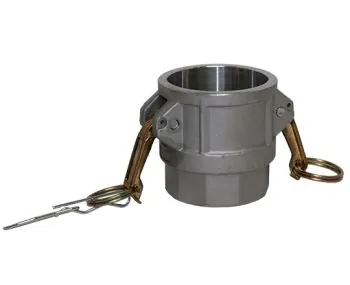
Gasket sits in the coupler face groove — the seal that EPDM/NBR/Viton/PTFE selection decides.
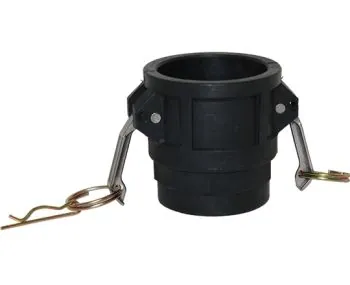
Plastic coupler on chemical duty — gasket compound matters more than body material alone.
Why the Gasket Is the Sealing Core
A cam and groove coupling seals by compression, not by the cams themselves. When you push a male adapter into a female coupler and close both cam arms, the cam lobes rotate over the adapter’s groove and draw the two faces together. That clamping force compresses the gasket — a flat elastomeric ring seated in a machined groove in the coupler bore — between the adapter shoulder and the coupler body. The compressed gasket is what blocks the leak path. The cams only supply the force; they never seal anything on their own.
Three practical consequences follow from that mechanism:
- A missing, damaged or wrong-compound gasket leaks even with both arms fully closed. This is the single most common “my camlock leaks” diagnosis in the industry.
- The gasket must be compatible with the fluid it touches — NBR for fuel and oil, EPDM for water and most dilute acids and alkalis, Viton (FKM) for solvents and high temperatures, PTFE for maximum chemical inertness.
- The sealing face must be clean. Grit, dried product or a scored adapter face creates a leak path no gasket can bridge.
The gasket sits in the female coupler half (types B, C, D and DC). Male adapters (types A, E, F, DP) carry no gasket. If you’re unsure which type is which, see our camlock coupling types guide before ordering spares.
Gaskets are also the cheapest component in the assembly — usually well under the cost of the metal halves — yet they decide whether the connection works. Treating them as an afterthought is how a fuel line loses a tank of product to save a few cents.
How Camlock Gaskets Are Made
Most camlock gaskets are molded elastomer rings — uncured compound is pressed into a mold and cured under heat, which gives the dense, flash-free surface that seats well against the adapter shoulder. PTFE gaskets are usually machined or stamped from virgin or filled PTFE stock rather than molded, because PTFE is a thermoplastic and does not cure like rubber.
The practical difference: molded elastomer gaskets conform to minor surface imperfections and recover when the coupling is opened; PTFE gaskets are dimensionally stable but have no elastomeric memory, so they rely on even clamp force instead of spring-back. That one difference explains most of the PTFE sealing quirks covered later in this guide.
The Four Main Gasket Compounds
Four compounds cover the overwhelming majority of camlock service worldwide. Each is strong where the others are weak, which is why there is no single “best” gasket — only the best gasket for your media.
NBR (Nitrile, Buna-N): The Fuel and Oil Standard
Nitrile butadiene rubber — NBR, still widely called Buna-N — is the default gasket for anything petroleum-based. Its defining property is excellent oil resistance: mineral oils, hydraulic fluids, diesel and gasoline cause minimal swelling, so the seal geometry stays stable in service.
Strengths: outstanding resistance to mineral oils and greases, diesel, gasoline (moderate swelling), kerosene, hydraulic fluids and lubricants; good mechanical strength and abrasion resistance; low cost; good low-temperature flexibility down to roughly -30°C (-22°F), with short excursions to about -40°F (-40°C) possible in low-temp grades.
Limitations: NBR has poor ozone and weathering resistance — sunlight, ozone from electric motors and outdoor exposure crack it over time, which is why fuel gaskets stored on a sunny rack age faster than those in a drawer. It also swells badly in ketones (acetone, MEK), aromatic solvents (toluene, xylene) and chlorinated solvents, and it is only fair in dilute acids and alkalis. Continuous service temperature is about 212°F (100°C); brief peaks to 250°F (121°C) are tolerated but shorten life.
Use it for: diesel and gasoline transfer, fuel dispensing, oil and hydraulic lines, lubricant handling, and any hydrocarbon service where EPDM would fail on contact.
EPDM: The Water, Weather and Ozone Workhorse
Ethylene propylene diene monomer rubber — EPDM — is the mirror image of NBR. It has outstanding resistance to water, hot water, steam, ozone and weathering, plus good resistance to most dilute acids, alkalis and polar solvents such as alcohols and ketones. What it cannot touch is oil: mineral oils, diesel, gasoline and hydrocarbon solvents swell and destroy EPDM quickly.
Strengths: the best all-round choice for water service — potable water, irrigation, dewatering, washdown and steam; excellent ozone and UV resistance, so it survives outdoor exposure and storage that would crack NBR; good performance in dilute acids and caustics; broad temperature range from about -40°F to 250°F (-40°C to 121°C) continuous, with steam-rated compounds used to about 300°F (150°C) intermittently; low cost.
Limitations: instant failure on mineral oils, fuels and hydrocarbon solvents — an EPDM gasket on a diesel line can swell, soften and extrude within hours. It also absorbs some aromatic fluids and is not the first choice for concentrated oxidizing acids.
Use it for: water, irrigation and fire-fighting lines, steam and hot water, dairy and beverage transfer (with food-grade compounds), dilute acid and alkali handling, and outdoor service where ozone and UV attack would destroy NBR. If you run both water and fuel through the same fleet of couplings, the safest practice is a dedicated gasket for each service — an EPDM gasket that has touched diesel is ruined even if it looks fine.
Viton (FKM): The Chemical-Line Premium
FKM — the fluoroelastomer class defined by ASTM D1418, most widely known by the commercial designation Viton — is the premium gasket for demanding chemical and high-temperature service. Its broad resistance to acids, bases, solvents and hydrocarbons, combined with continuous ratings around 200°C (392°F), makes it the standard answer for chemical transfer lines.
Strengths: excellent resistance to mineral oils, fuels (including aviation fuel), most acids, most alkalis at moderate temperature, aromatic and aliphatic hydrocarbons, and many solvents; handles continuous service to about 392°F (200°C) with short peaks higher; very low permeability, so it holds volatile products better than NBR or EPDM; good ozone and weathering resistance.
Limitations: price — several times the cost of NBR or EPDM; attacked or swollen by ketones (acetone, MEK), esters and some amines, so it is not a universal chemical gasket; poor low-temperature flexibility below about -20°C (-4°F); hot concentrated caustic and some hot acids shorten life.
Use it for: chemical loading and unloading lines, acid and solvent transfer, aviation and racing fuel, hot process lines, and any service where the media list is long enough that guessing wrong gets expensive. On aggressive chemical duty the safe default pairing is a 316 stainless body with an FKM gasket — see our chemical transfer guide for the full material logic.
PTFE: Maximum Inertness, Different Sealing Rules
Polytetrafluoroethylene — PTFE, also sold as TFE — is the most chemically inert gasket material available. It is attacked by almost nothing in normal industrial service: concentrated acids, strong caustics, virtually every solvent, oxidizers and fuels all leave it unchanged. Its temperature range is the widest of the four, from about -328°F to 500°F (-200°C to 260°C).
Strengths: essentially universal chemical compatibility; the widest temperature range; non-stick surface that resists product build-up; zero ozone or weathering degradation; FDA-listed for food contact (perfluorocarbon resins, 21 CFR 177.1550).
Limitations: PTFE is not an elastomer. It does not spring back, so it cannot self-energize like rubber; under sustained compression it cold-flows (creeps), which is why plain PTFE gaskets need even, moderate clamp force and can weep at low pressure or under vibration. It is hard — roughly 55–60 Shore D versus 60–80 Shore A for rubber — so it conforms poorly to scratched or pitted sealing faces. For pressure service, suppliers use thicker cross-sections, encapsulated designs or spring-energized constructions; for camlock duty this means PTFE gaskets work well on clean faces at moderate pressure but are not a drop-in upgrade for a badly worn coupling.
Use it for: aggressive chemical service where FKM is marginal, high-temperature lines, oxygen and oxidizer service where organic rubber is a fire risk, and food or pharmaceutical lines where zero migration matters.
Gasket Compound × Media Compatibility
Ratings are for standard commercial compounds at ambient to moderate temperature. Concentrated media, elevated temperature and long exposure all shift ratings down — when in doubt, verify against the compound’s published chart or ask for a compatibility statement.
| Media | NBR | EPDM | Viton (FKM) | PTFE |
|---|---|---|---|---|
| Water | Good | Excellent | Excellent | Excellent |
| Hot water / steam | Fair | Excellent | Good | Excellent |
| Mineral oil / hydraulic fluid | Excellent | Poor | Excellent | Excellent |
| Diesel fuel | Excellent | Poor | Excellent | Excellent |
| Gasoline | Good | Poor | Excellent | Excellent |
| Dilute acids | Fair | Good | Excellent | Excellent |
| Alkalis / caustic | Fair | Excellent | Fair | Excellent |
| Aromatic solvents (toluene, xylene) | Poor | Poor | Good | Excellent |
| Ketones (acetone, MEK) | Poor | Fair | Poor | Excellent |
| Food contact (FDA compounds) | Good | Excellent | Good | Excellent |
| Beer / beverage | Fair | Excellent | Good | Excellent |
| Ozone / weathering | Poor | Excellent | Excellent | Excellent |
Legend: Excellent = long service life with negligible effect; Good = suitable with normal inspection; Fair = limited service, verify under your exact conditions; Poor = swells, degrades or fails — do not use.
Three patterns worth memorizing:
- NBR and EPDM are opposites. If the media is petroleum, it is NBR; if it is water, weather or dilute caustic, it is EPDM. The two must never be swapped.
- FKM sits in the middle and above. It handles both petroleum and most chemicals, which is why it is the “not sure, go premium” answer — at a premium price.
- PTFE sits above everything chemically, but pays for it with sealing behavior that needs correct installation and a clean sealing face.
Temperature Range Comparison
Temperature ratings are for the gasket compound alone, not the whole coupling assembly. The body material and the pressure rating of the coupling derate with temperature too — a gasket that survives 400°F is useless in a polypropylene coupling rated to about 176°F (80°C). Check the whole assembly.
| Compound | Continuous service | Short-term peak | Low-temperature behavior |
|---|---|---|---|
| NBR | -22°F to 212°F (-30°C to 100°C) | ~250°F (121°C) | Stiffens below about -30°C; low-temp grades reach -40°F |
| EPDM | -40°F to 250°F (-40°C to 121°C) | ~300°F (150°C) steam-rated grades | Stays flexible to about -40°F |
| Viton (FKM) | -4°F to 392°F (-20°C to 200°C) | ~430°F (220°C) brief | Embrittles below about -20°C |
| PTFE | -328°F to 500°F (-200°C to 260°C) | ~500°F (260°C) | No practical embrittlement in range |
Two temperature facts that matter in practice:
- Heat accelerates chemical attack. As a rule of thumb, elastomer degradation roughly doubles for every 10°C (18°F) rise in temperature. A compound that survives a chemical for years at 70°F may fail in months at 150°F — always match the gasket to the hot case, not the storage temperature.
- Cold makes rubber stiff. A gasket that seals fine at 60°F can weep at -20°F as it hardens, especially NBR and FKM. If your line runs outdoors in winter, weight the low-temperature column as heavily as the high-temperature one.
Hardness (Shore A) and Sealing Performance
Elastomer hardness is measured on the Shore A scale, with typical camlock gaskets in the 60 to 80 Shore A range. Hardness is a trade-off, not a quality score:
- Softer compounds (60–70 Shore A) conform to minor scratches, pits and surface waviness on the adapter face, which means better sealing on used or imperfect hardware. They also seal at lower clamp force — useful at low line pressure, where a hard gasket can leave a gap.
- Harder compounds (75–85 Shore A) resist extrusion into the gap between the adapter and coupler at high pressure, and resist abrasion from gritty product and frequent connect/disconnect cycles. The price is less conformance: on a scored face, a hard gasket leaks where a soft one would not.
Typical values: NBR and EPDM gaskets are commonly formulated around 70 Shore A; FKM gaskets often land at 70–80 Shore A; PTFE is far harder at roughly 55–60 Shore D (a different, higher scale), which is exactly why it conforms poorly and needs even clamp force.
For a given line, the practical rule: low pressure and imperfect hardware → softer compound; high pressure and abrasive or hot service → harder compound. If you have both (high pressure on a beat-up coupling), fix the hardware — no gasket hardness fixes a badly scored sealing face.
Gasket Designs: Flat, Lip and Four-Lip
Beyond the compound, gaskets differ in cross-section profile. The profile controls how the gasket deflects under pressure and how much clamp force it needs.
- Flat ring gasket — the industry default and the design used in standard A-A-59326 / EN 14420-7 camlock assemblies. A plain rectangular cross-section ring seated in the coupler groove; it seals purely by compression between the adapter shoulder and the coupler body. Simple, cheap, interchangeable, and correct for the large majority of water, fuel and chemical lines.
- Lip-type gasket — one face is molded with an angled sealing lip that deflects under pressure, using the line pressure itself to push the lip harder against the adapter. Lip designs seal at lighter clamp force and tolerate slight misalignment better, which is why some suppliers fit them to couplings used on gravity or low-pressure lines.
- Four-lip gasket — four concentric sealing points instead of one wide contact band. Four-lip designs give redundant sealing surfaces and are often specified on premium or safety-critical connections; they cost more and require correct orientation to work.
Orientation matters on lip and multi-lip designs: the lip side faces the media side of the joint — check the supplier’s marking or drawing, because installing a lip gasket backwards can actually create a leak path. Flat gaskets are symmetric and cannot be installed wrong.
Which profile should you buy? If your coupling came with a flat gasket and sealed fine, replace like-for-like. Consider a lip or four-lip profile only when a flat gasket weeps at low pressure on an otherwise sound coupling — and expect to pay slightly more per piece.
Replacement Cycle and Aging Signals
There is no universal gasket lifetime. A coupling that stays connected indoors may keep its gasket for years; the same gasket on a fuel truck disconnected fifty times a day may need replacing monthly. What is universal is that gaskets are consumables — they age whether or not they leak, and they fail from time, temperature, chemicals and ozone even when the metalwork looks new.
Inspection frequency: check the gasket every time you disconnect on critical or chemical lines; at minimum, inspect every coupling’s gasket on a quarterly maintenance schedule. Replace on schedule, not on failure, after heavy chemical exposure, and after the coupling has been apart many times.
The five aging signals that mean replace now:
- Hardening — the gasket no longer flexes easily when bent. A healthy elastomer gasket bends without cracking; a hardened one feels like plastic. This is the earliest and most common failure signal, and it happens invisibly in service.
- Surface cracking — visible cracks, especially at the inner and outer edges. Cracks are leak paths. Ozone and UV attack show up first as fine surface crazing on NBR.
- Compression set — the gasket stays permanently flattened or shows an indented ring where the adapter pressed it. Once it has taken a set, it no longer pushes back with sealing force.
- Swelling or softening — a gasket that has absorbed incompatible media grows, softens or feels greasy. Swollen EPDM on a fuel line is the classic example; the gasket will extrude out of the groove.
- Discoloration and tackiness — chemical attack often darkens or lightens the compound and leaves the surface sticky.
Storage rules that extend gasket life: store spares flat, in a cool, dark, dry place, away from electric motors and welding areas (both generate ozone), and away from direct sunlight. Keep them in sealed bags with the compound marked. Never store gaskets stretched over a fitting — that pre-loads the rubber and accelerates set.
Stocking rule: keep spares for every size and compound you run. A gasket costs cents; the downtime to fetch one from a supplier hours away does not. Mark the compound on your spares bin — an EPDM gasket that ends up on a diesel line ruins the connection and possibly the day.
How to Install a Camlock Gasket
A gasket change takes under a minute on an open line — if you do it right. The four steps:
- Remove the old gasket. It usually peels out of the machined groove in the coupler face; a plastic or brass pick helps if it is perished. Do not use a steel screwdriver — a scratch in the groove becomes a permanent leak path.
- Clean the groove. Grit, dried product and old compound residue under the new gasket re-introduce the exact leak you are fixing. Wipe the groove and the adapter shoulder with a clean rag; for stubborn residue use a solvent compatible with the new gasket compound.
- Seat the new gasket evenly. Work it into the groove so it lies flat, untwisted and fully home. A twisted or proud gasket pinches between the halves and leaks. Confirm the compound is the one you specified before fitting — verify the marking, or match it against the old gasket.
- Lubricate lightly (where appropriate). A thin film of the service fluid, or a compatible grease, helps the gasket seat and the adapter slide in without rolling the gasket. Never use petroleum grease on EPDM — it attacks the compound. On food or beverage lines, use a food-grade lubricant or none at all.
- Connect and test. Close both arms fully, then pressure-test at low pressure before putting the line into service. Check for weep at rest before ramping to full flow.
Orientation recap: flat gaskets are symmetric — install either way. Lip and four-lip gaskets are directional: lip side toward the media/pressure side per the supplier’s marking.
Leak Troubleshooting: Gasket, Arm or Size?
When a camlock connection weeps, the cause is almost always one of three things. Work through them in order rather than replacing parts at random.
1. Gasket problems (the most common):
- Gasket missing, cracked, hardened or swollen → replace with the correct compound.
- Gasket twisted or not fully seated in the groove → re-seat.
- Wrong compound for the media → the gasket may look fine while swelling slowly; check for softening and fit.
- Debris under the gasket → clean groove and sealing faces.
2. Arm problems:
- One or both arms will not snap fully closed → worn cam lobes, bent handles, debris in the cam mechanism, or a safety pin interfering. Both arms must close past center; a half-closed arm can blow off under pressure.
- Arms close but with uneven force → the clamp force is asymmetric, so the gasket compresses on one side and leaks on the other. This is an arm/wear issue, not a gasket issue — new gaskets will not fix it.
- Arms are stiff or sloppy → lubricate the pivot pins or replace the coupling; worn pivots cannot generate consistent sealing force.
3. Size and type problems:
- Mismatched nominal sizes → a 2” adapter will not seat correctly in a 1½” coupler; check the size stamp on both halves. Camlock sizes refer to nominal hose bore, not outside diameter.
- Wrong type pairing → two female halves or two male halves cannot seal; male adapters mate only with female couplers of the same size.
- Damaged adapter groove or burrs on the adapter shoulder → the gasket has nothing clean to compress against; dress the burr or replace the adapter.
- A leak at the threaded back (NPT/BSPT connection) is not a gasket problem at all — it is a thread-seal problem. Wipe the joint dry and watch where the wet starts: cam joint = gasket, thread = tape or sealant.
Diagnostic sequence for a weeping camlock: (1) Is the wet at the cam joint? (2) Are both arms fully closed? (3) Is the gasket present, clean, correctly seated and the right compound? (4) Are the adapter face and groove undamaged? (5) Do the sizes match? Running that order catches roughly nine out of ten leak causes without replacing anything.
Food-Grade Gaskets and FDA Compliance
Food, beverage and pharmaceutical lines need compounds certified for food contact — a standard industrial EPDM or NBR gasket is not automatically food-safe, because the compound may contain plasticizers, accelerators or fillers that can migrate into the product.
The relevant US regulation for elastomer gaskets is FDA 21 CFR 177.2600 — rubber articles intended for repeated use — which lists permitted ingredients and extraction limits for rubber that contacts food. PTFE gaskets fall under 21 CFR 177.1550 (perfluorocarbon resins). In addition, food equipment materials are commonly specified to NSF/ANSI 51, and dairy lines to 3-A Sanitary Standards.
Practical guidance for food and beverage service:
- Food-grade EPDM is the default for water, dairy, beverage and washdown service — it does not taint and handles hot water and steam cleaning cycles.
- Food-grade NBR suits oily food products and edible oils.
- Food-grade FKM covers hot or aggressive food processes.
- PTFE is the zero-migration choice for pharmaceuticals, high-purity water and aggressive cleaning chemistries, at the cost of its harder sealing behavior.
Beer and brewing deserve a special note: brewing lines favor EPDM or PTFE because standard compounds can impart flavor taint, and because breweries cycle hot caustic cleaning (CIP) and steam (SIP) — a combination that kills NBR quickly. If you are building or extending a brewing, dairy or food line, read our dedicated food grade guide for compound, body material and cleaning-cycle requirements.
One caution: “food grade” is not a single universal certification. Confirm the compound carries an FDA 21 CFR 177.2600 statement (or an equivalent national approval) from the supplier and keep the documentation for audits — a verbal “it’s food safe” is not a compliance record.
FAQ
How do I know which gasket compound my camlock has? Check the supplier’s documentation or the compound marking if present. Some suppliers color-code compounds, but color coding is not standardized across brands — never identify a compound by color alone. When in doubt, replace with a known compound and label your spares.
Is the gasket in the male adapter or the female coupler? The female coupler (types B, C, D, DC). Male adapters (types A, E, F, DP) carry no gasket. Order gaskets by coupling size and compound, not by type letter.
Can I use EPDM on a diesel line? No. Diesel is a hydrocarbon; EPDM swells, softens and extrudes. Use NBR or FKM for diesel and gasoline. The reverse mistake — NBR on a water line — is less catastrophic but still wrong, because NBR ages fast in hot water and ozone.
Why does my camlock leak at low pressure but hold at high pressure? A gasket that seals only under high clamp or high line pressure is usually hard (aged), or the coupling has a worn arm that cannot generate enough force at rest. Replace the gasket first; if the weep persists, check the arms and the adapter face.
Are camlock gaskets interchangeable between brands? Standard cam and groove couplings built to A-A-59326 (formerly MIL-C-27487) or EN 14420-7 share the same gasket groove dimensions, so standard flat gaskets are dimensionally interchangeable. Lip and four-lip designs vary by manufacturer — fit them per the supplier’s orientation instructions.
Should I lubricate a camlock gasket? A light film of the service fluid or a compatible grease helps seating and extends gasket life by reducing friction on connect/disconnect. Use nothing on food lines except food-grade lubricant, and never petroleum grease on EPDM.
How often should I replace camlock gaskets? There is no universal interval. Inspect at every disconnect on chemical and critical lines and at least quarterly elsewhere; replace on any aging signal (hardening, cracking, compression set, swelling), after heavy chemical exposure, and before seasonal shutdown or startup. Stock spares for every size you run.
What is the difference between a gasket and an O-ring? A gasket is a flat ring that seals between two flat faces; an O-ring has a round cross-section and seals in a round groove. Camlock couplings use flat gaskets — never fit an O-ring where a flat gasket belongs.
Get the Right Gasket, First Time
Gasket selection is a one-question exercise once you know the media: petroleum → NBR; water, weather or caustic → EPDM; aggressive chemicals or high temperature → FKM; maximum inertness → PTFE. But the details — concentration, temperature, pressure, cleaning cycles — decide whether the textbook answer survives your actual line.
Tell us the media, temperature, pressure and size and we will confirm the gasket compound (and the coupling body material to match) with the figures, not a guess. OEM and custom marking available, with FDA/NSF documentation supplied for food-grade compounds.
Send your inquiry with: media · temperature · pressure · size · quantity — we reply within 24 hours.