
Food Grade Camlock Couplings: Stainless Fittings for Food, Beverage and Homebrew
Camlock couplings move a lot of food-grade liquids — milk, juice, edible oil, syrup, wine and beer — through transfer and filling lines. Food service changes the selection rules: the material has to survive caustic washdowns, the gasket has to be food-contact safe, and the whole fitting has to stay clean. Here is how to spec camlocks for food and beverage duty, including the homebrew market where stainless camlocks are now standard kit.
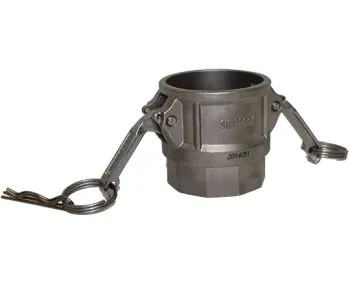
Stainless coupler — the washdown and CIP-capable choice for food duty.
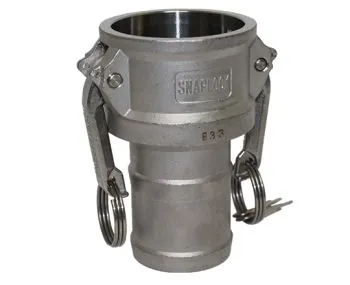
Type C stainless on a hose end for milk, juice and beer transfer.
Material: stainless is the food-service default
- 304 stainless steel — the standard food-grade material: corrosion-resistant, handles hot caustic and acid cleaners, no taste transfer. Spec 304 for milk, juice, oil, syrup and brewing.
- 316 stainless steel — for higher chloride exposure (brine, salty wash water, marine-adjacent plants) or where food acids are aggressive.
- Polypropylene — food-grade PP grades are used for dry food contact, potable water and some beverage duties where metal is undesirable; check FDA/contact certification for the specific grade.
- Aluminum and brass are not recommended for food contact: aluminum reacts with acidic foods and cleaners; brass contains lead-bearing alloys that are not acceptable in food service. Keep them out of food lines.
Gaskets: FDA contact matters
The gasket touches the product, so it must be a food-contact material:
- EPDM (food grade) — the default for water-based foods and beverages; resists CIP washdown chemicals
- Silicone — broad temperature range (-60°F to +400°F), no taste, popular in dairy and brewing
- PTFE — maximum inertness for aggressive food chemicals; harder seal, costs more
- NBR is not a food-contact choice — it is the fuel/oil gasket; it imparts taste and is not FDA-grade for food service
Gaskets for food service are available with FDA 21 CFR 177 compliance; when a line is audited, the gasket spec is one of the first things inspectors check.
Where camlocks fit in a food plant
- Transfer lines: tanker offload → storage tanks → process vessels (A + C pump-to-hose layouts, same as industrial)
- Filling lines: filler supply hoses and batch changeover points where a quick disconnect saves downtime
- Blending and batching: syrup, concentrate and brine make-up stations
- CIP return lines: temporary hookups (note: the cam-and-groove design has internal grooves that are not CIP-cleanable by design — use camlocks on non-sterile utility connections, and tri-clamp or welded sanitary fittings on product-critical sterile lines)
Homebrew camlock fittings
Homebrewers adopted camlocks as the standard quick-connect for brewing rigs — kettle outlets, pump inlets, fermenter hoses and counterflow chillers. The classic build uses Type B (female threaded) on equipment ports and Type C (male hose shank) on hoses, with 1/2” the dominant size and 3/4” for high-flow recirculating systems. Stainless is non-negotiable for brewing (aluminum and brass react with wort pH); EPDM or silicone gaskets are standard. For brewers: 1/2” stainless Type B + Type C pairs, gaskets in bulk.
Sizing and pressure
Food transfer lines run low pressure — 30-80 psi is typical. Reference rating: 1/2” stainless camlocks are rated well above that (the standard table gives 1/2” stainless roughly 350 psi working pressure). Size by flow: 1/2” for typical filling lines, 3/4”-1” for higher flow transfer, 2” for bulk tanker rates.
Food-plant considerations
- Clean after every run — sugar and dairy residues harden in the groove and become harborage. Rinse, then CIP or manual wash.
- Sanitize before sterile-duty connections — camlocks are quick disconnects, not sterile connections; sanitize the gasket face before hooking up to a finished-product line.
- Keep food gaskets separate — do not run the same gaskets on chemical or fuel lines and back on food lines.
- Buy certified gaskets with documentation — food plants get audited; keep the FDA compliance paperwork.
Checklist for a food-grade order
- Sizes: 1/2” (homebrew/utility), 3/4”-2” (process and transfer)
- Types: B (female threaded) for equipment ports, C (male hose shank) for hoses, A + C for pump-to-line
- Material: 304 stainless (default), 316 (chloride duty), food-grade PP (specialty)
- Gasket: food-grade EPDM or silicone, with FDA 21 CFR 177 documentation
- Extras: dust caps and plugs (keep food hoses capped), spare gaskets
Send us your liquid, line sizes and washdown regime and we will confirm the stainless set — with the right food-contact gaskets.
Related guides
- Camlock material guide: stainless vs aluminum vs brass vs PP — why stainless wins food duty
- Camlock gasket selection: NBR vs EPDM vs Viton vs PTFE — food-contact gasket rules
- Camlock coupling types explained: A to F, DC and DP — matching types for pump, hose and tank
- Camlock vs tri-clamp — when sanitary tri-clamp beats camlock