
Camlock vs Storz vs Bauer vs Tri-Clamp: Which Quick Coupling Fits Your Line?
Four hose couplings look interchangeable from a distance. They are not. Camlock, Storz, Bauer and tri-clamp each solve a different problem, and mixing them on one line is how leaks, pressure drops and compatibility headaches start. This guide explains how each mechanism works, where each standard is actually used, and which one belongs on your pump, hose, tank or process line.
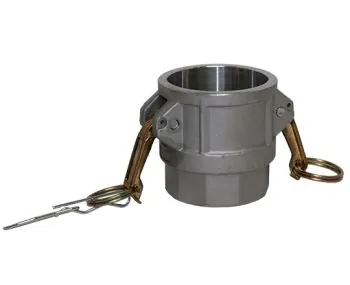
Camlock: cam-arm clamping, the reference point of this comparison.
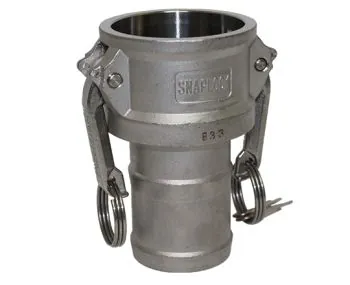
Where Tri-Clamp and Bauer enter the decision — sanitary and washdown lines.
Four Quick-Connect Mechanisms at a Glance
Every quick coupling in this comparison solves the same base problem — joining two hoses or pipes without tools, in seconds, with a repeatable seal. The differences are in how the connection locks, how hard it can be pushed, and what the industries around it demand.
- Camlock (cam and groove). A male adapter pushes into a female coupler and two hinged cam arms snap over a groove on the adapter. Tool-free, about three seconds, used everywhere from water transfer to fuel and chemicals. The default general-purpose quick disconnect.
- Storz. Two identical halves with interlocking lugs connect with a quarter turn and a gasket seal. Because both halves are the same, any Storz mates with any Storz of the same size. The fire-service standard across much of the world.
- Bauer. A threaded collar with an internal locking ring that screws over the male spigot. Heavier, slower, and built for large-diameter suction and discharge lines moving slurry, wastewater and irrigation water.
- Tri-clamp. Two ferrules are butted together with a gasket between them and held by a band clamp. No threads, no cams — just clamp pressure. The sanitary standard for food, dairy, beverage and pharmaceutical lines that must be cleaned in place.
These four are not interchangeable. Each locking mechanism is physically different, and a camlock adapter will not seat in a Storz coupling any more than a tri-clamp ferrule will lock into a Bauer collar. The rest of this guide is about choosing correctly before you buy, and about what an adapter can — and cannot — do when you are stuck with mixed systems.
Camlock: The General-Purpose Workhorse
Camlock — short for cam and groove — is the most widely used quick-disconnect coupling in industry. One half is the male adapter: a plug with a circumferential groove machined around its body. The other half is the female coupler: a socket with two pivoting cam arms. You push the adapter into the coupler, snap both arms down, and the cam lobes catch the groove and draw the two faces together.
How the seal works
The seal does not come from the cams. The coupler’s bore carries a flat elastomeric gasket; when the arms close, the adapter is pulled tight against that gasket and the compression does the sealing. The cams only supply clamping force. Three practical consequences follow:
- A missing, cracked or wrong-material gasket leaks even with both arms fully closed — the most common camlock failure mode.
- The gasket must be compatible with the fluid: NBR for fuel and oil, EPDM for water and most acids, Viton for solvents and high heat, PTFE for maximum chemical resistance.
- A dirty groove or a scored adapter face breaks the seal, which is why dust caps and plugs matter more than buyers expect.
Connection steps
- Open both cam arms fully.
- Insert the male adapter until it seats against the gasket.
- Close both arms; each lobe catches the groove and snaps past center. Both arms must be fully closed — a half-closed arm can blow off under pressure.
Disconnect is the reverse: open both arms, withdraw the adapter. No rotation, no thread engagement, no tools.
Pressure, sizes and materials
Working pressure depends on size and material. Aluminum and stainless camlocks in the common 1”–4” range are typically rated in the 150–250 psi band at ambient temperature, while larger sizes derate substantially — a 6” aluminum coupling may be rated closer to 60–100 psi, which is why the honest working range across the standard size ladder is roughly 60–250 psi. Stainless at the same size out-rates aluminum; polypropylene is the low-pressure option for aggressive chemicals at ambient temperature.
Standard sizes run ½” through 6” in the catalog range, with 8”–12” available in heavy industrial ranges. Threaded backs come in NPT (North America) or BSPT (UK/Europe/Asia) — the thread standard must be confirmed on every order, because a 2” NPT camlock will not thread onto a 2” BSPT pipe.
The type system
Camlock parts are organized by type letters that describe the non-cam end: Type A (male adapter, female NPT back), Type B (female coupler, male NPT back), Type C (female coupler, hose shank), Type D (female coupler, female NPT back), Type E (male adapter, hose shank), Type F (male adapter, male NPT back), plus DC dust caps and DP dust plugs. Any male type mates with any female type of the same size. The full breakdown lives in our camlock coupling types guide.
Typical industries
Agriculture and irrigation, fuel delivery, chemical transfer, dewatering, marine loading, food transfer and general industrial water. Four body materials — aluminum, stainless 304/316, brass and polypropylene — plus four gasket families cover most of what industry actually moves.
Where it wins: general transfer at any scale; the cheapest quick-connect that can be had in aluminum; parts interchangeable across manufacturers that build to A-A-59326D, EN 14420-7 or MIL-C-27487.
Where it loses: fire hose (Storz owns that standard), ultra-clean sanitary process lines (tri-clamp), and high-pressure hydraulic or steam service (threaded or flanged fittings).
Storz: Fire and Water Logistics
Storz couplings connect two identical halves: each half carries a set of lugs that interlock with the other’s when rotated a quarter turn, and an integral gasket seals the joint. The defining feature is that there is no male and female — any Storz half mates with any other Storz half of the same size.
Connection steps
- Align the lugs of the two halves.
- Push the halves together.
- Rotate one half a quarter turn (90°) until the lugs seat fully; the gasket compresses as the rotation completes.
That is it. The quarter-turn action is one of the fastest connections in the comparison, and the hermaphroditic design means a fire crew never has to hunt for the “other half” — every end connects to every end.
Pressure, sizes and materials
Fire-service Storz couplings are rated in the region of 8 bar (~116 psi) for standard hose couplings, with industrial and high-pressure variants rated higher. Sizes commonly run 1” through 6” (roughly 25–150 mm), matching fire hose, hydrant and large-diameter supply line dimensions. Bodies are typically aluminum or a coated light alloy, which keeps weight down — important for equipment carried by hand.
The standards
Storz is defined by the DIN 14301–14308 family of German fire-fighting standards, and it is the dominant fire coupling standard across Europe and much of the rest of the world, with growing adoption by fire departments elsewhere. Because the standard is public and dimensional, couplings from different manufacturers and different municipalities mate reliably.
Typical industries
Fire departments (hose, hydrant connections, pump intakes), municipal water, irrigation pumping and any operation where crews connect and disconnect hoses hundreds of times per day.
Where it wins: speed, weight, and the identical-halves simplicity that keeps stock minimal and mistakes rare. It is also remarkably forgiving of rough handling — a fire ground is not a clean room.
Where it loses: aggressive chemicals (limited material range), high pressure beyond fire-service ratings, and anything that needs a threaded, welded or flanged connection — Storz is a hose-and-hydrant system, not a piping system. See our fire department water supply guide for how camlock and Storz work side by side in fire operations.
Bauer: Slurry, Wastewater and Pumps
Bauer couplings — built to the DIN 14251 German standard, often called “Bauer GS” — are the heavyweights of the group. The female half carries a threaded collar with an internal locking ring; you push the male spigot into the female half and screw the collar down so the ring engages over the spigot’s shoulder.
Connection steps
- Insert the male spigot into the female half.
- Rotate the threaded collar by its grip points until it bottoms out and the locking ring seats over the spigot shoulder.
- Check the collar is fully home; a partially engaged collar can spin under load.
The collar needs a few turns, which is why connection takes roughly 5–10 seconds — slower than camlock or Storz, but the threaded engagement is deliberately more positive.
Pressure, sizes and materials
Bauer couplings are rated up to about 16 bar (~232 psi) depending on size and configuration. The typical range is 2” through 6”, with larger diameters for big irrigation and pump-station duty. Aluminum is the dominant body material for the classic range, with steel and stainless variants for abrasive or more demanding service.
Why Bauer survives where camlock wears out
The locking collar resists accidental disconnection under vibration far better than cam arms. On a pump discharge line that shakes all day, or a suction hose that gets dragged across a yard, the threaded collar stays engaged while a camlock handle could work loose or be knocked open. The coupling is also built with thicker walls and heavier lugs, which is why it shrugs off rough handling.
Typical industries
Agricultural irrigation mains, slurry and manure handling, wastewater, dredging and pump stations, and heavy suction/discharge duty. If the line is large-bore, vibrates, and moves dirty water, Bauer is the classic answer.
Where it wins: positive locking under vibration, large diameters, solids-laden media, and abuse resistance.
Where it loses: speed of connection, fine chemicals (fewer material and seal options than camlock), price point — Bauer is typically more expensive than camlock at the same size — and any service that needs frequent connect/disconnect cycles.
Tri-Clamp: Sanitary Food and Pharma
Tri-clamp — also called tri-clover or sanitary clamp — is a different species of connection. Two ferrules, each welded or clamped to the end of a pipe or fitting, are butted together with a gasket between them and held by a single band clamp that tightens over both ferrules’ outer lips.
Connection steps
- Place the gasket over the ferrule face of one side.
- Butt the second ferrule against it, trapping the gasket between the two faces.
- Fit the band clamp over the two ferrules and tighten the clamp — by hand knob, wing nut or tool.
- Verify the gasket is not pinched or extruded out of the joint.
That is roughly 30–60 seconds per connection, which makes tri-clamp the slowest of the four — but the speed trade-off buys the highest hygienic standard.
The sanitary design
Two things make tri-clamp the food and pharma standard. First, the connection is crevice-free: when the gasket is correctly seated, the bore is smooth and continuous with no thread, cam pocket or internal groove where product could collect. Second, the whole joint disassembles completely — the clamp comes off, the gasket drops out, and both ferrules are fully exposed. That combination is what makes cleaning in place (CIP) and steam sterilization (SIP) practical, and it is why inspectors and auditors look for tri-clamp joints on process lines.
Pressure, sizes and materials
Working pressure with a correctly fitted clamp and gasket is typically up to about 150 psi (10 bar), declining with size. Common sizes run ½” through 4” in process skids, with larger ferrules (6”–12”) used on tanks and big transfer lines. The material is overwhelmingly polished 316L stainless steel with sanitary gaskets — EPDM, silicone, Viton or PTFE — chosen for the product and cleaning chemicals.
The standards
Tri-clamp dimensions follow ISO 2852 and DIN 32676, and the design intent is codified in 3-A and EHEDG hygienic design guidance. That regulatory backing is exactly why food, dairy, beverage and pharmaceutical processors standardize on it.
Typical industries
Food and dairy processing, beverage and brewery lines, pharmaceutical and biotech manufacturing, cosmetics, and any clean-room or hygienic transfer duty.
Where it wins: hygiene, complete disassembly for inspection, CIP/SIP compatibility, and audit-ready compliance.
Where it loses: speed, pressure ceiling, rough outdoor duty (the clamp and gasket are delicate by comparison), and price — polished stainless tri-clamp hardware is the most expensive of the four.
Interchangeability: What Mates with What
The short answer: nothing crosses. A camlock adapter does not mate with a Storz coupling. A Storz half does not engage a Bauer collar. A Bauer spigot does not seat in a tri-clamp ferrule. Each mechanism has its own locking geometry, and there is no “universal” quick coupling that accepts all four.
The important nuance is the second-level rule: parts are interchangeable within a standard, not across standards.
- Camlock: any male type (A, E, F, DP) mates with any female type (B, C, D, DC) of the same nominal size — but only if both halves are built to the same dimensional standard (A-A-59326D, EN 14420-7 or MIL-C-27487). That is what allows a coupler from one manufacturer to mate with an adapter from another.
- Storz: any half mates with any half of the same size, period — the hermaphroditic design was the point.
- Bauer: DIN 14251 parts from different suppliers mate if the size class matches; the collar and spigot dimensions are standardized.
- Tri-clamp: ferrules, clamps and gaskets follow ISO 2852 / DIN 32676; a 2” ferrule takes a 2” clamp and a 2” gasket, regardless of supplier — but mixing a 2” ferrule with a 2½” clamp does not seal.
Two practical warnings before you buy adapters. First, size must match nominal size — a 2” camlock will not accept a 1½” adapter even if both are camlock. Second, thread standards are not interchangeable — a camlock-to-Storz adapter with an NPT thread will not connect to a BSPT pipe, and the same trap exists on every thread-back adapter in the catalog.
Four-Way Comparison Table
| Dimension | Camlock (cam & groove) | Storz | Bauer | Tri-clamp |
|---|---|---|---|---|
| Locking mechanism | Two hinged cam arms over a groove | Interlocking lugs, quarter turn | Threaded collar with internal cam ring | Band clamp over two ferrules |
| Connection speed | ~3 seconds | ~2–3 seconds | ~5–10 seconds | ~30–60 seconds |
| Tools required | None | None | None | Clamp + gasket (and a wrench for larger sizes) |
| Working pressure | 60–250 psi by size and material | ~116 psi fire-service, higher industrial | Up to ~232 psi | Up to ~150 psi with gasket |
| Size range | ½” – 6” standard (to 12” industrial) | 1” – 6” | 2” – 6” (larger for heavy duty) | ½” – 4” common (larger on tanks) |
| Seal | Compressed gasket in coupler groove | Gasket in the female half of the pair | Gasket compressed by the locking collar | Sanitary gasket trapped between ferrules |
| Hygiene level | Good — gasket-sealed, but internal groove and cam pockets | Good — gasket-sealed, smooth-ish bore | Moderate — threaded collar and internal ring | Excellent — crevice-free, fully disassemblable |
| Relative cost | Low–moderate (aluminum cheapest of the four) | Low | Moderate | High (polished stainless) |
| Typical media | Water, fuel, chemicals, food, agriculture | Fire, water, irrigation | Slurry, wastewater, pump-station duty | Food, dairy, beverage, pharma, biotech |
| Standards | A-A-59326D, EN 14420-7, MIL-C-27487 | DIN 14301–14308 (fire), related national variants | DIN 14251 (Bauer GS) | ISO 2852, DIN 32676, 3-A / EHEDG design intent |
Read the table as a decision filter. If you need the cheapest tool-free coupling for water, fuel or chemicals → camlock. If the job is fire service or hydrant work → Storz. If it is large-bore dirty water under vibration → Bauer. If it is a hygienic process line → tri-clamp.
Application Assignments: Which Coupling for Which Job
| Application | Recommended coupling | Why |
|---|---|---|
| Fire hose, hydrant connections, fire pump intakes | Storz | Quarter-turn speed, identical halves, department-standardized, light enough to carry |
| Agriculture, chemical transfer, fuel delivery, dewatering | Camlock | Fast, cheap, four materials cover water to aggressive acids, huge part availability |
| Irrigation mainlines, slurry, wastewater, pump stations | Bauer | Large diameters, positive threaded lock that resists vibration, abuse-tolerant |
| Food, dairy, beverage, pharmaceutical process lines | Tri-clamp | Crevice-free joints, full disassembly, CIP/SIP compatibility, audit-ready |
| Potable water supply to a tank or reservoir | Camlock | Food-grade gaskets and stainless/aluminum bodies, dust caps keep fill ports clean |
| Truck-to-tank or tank-to-truck transfer | Camlock | Fastest repeated connect/disconnect cycles at the lowest cost |
The pattern is not random: the further a line gets from the process (fire ground, reactor, field) and the closer it gets to plain transfer, the more likely camlock is the right answer. That is why a fire department can run Storz on the hose and still find camlock on the supply side — the two standards are not competitors, they are neighbours in the same water logistics chain.
Camlock vs Storz: Fire Hose Standard vs Supply-Side Standard
The camlock vs Storz question almost always comes from fire, municipal water or industrial fire-water systems, and the honest answer is that most fire operations need both.
Why fire hose uses Storz
Fire hose must be connected and disconnected hundreds of times per shift, by crews wearing gloves, often in the dark, sometimes under stress. The requirements are brutal and specific:
- Speed. A quarter turn beats a two-hand cam-arm closure, and any half mates with any half — no lining up male-to-female.
- No tools, no parts. A Storz connection has no separate gasket to lose and no handle to knock open; the gasket is captive in the half.
- Standardization. DIN 14301–14308 gives every department and every manufacturer one dimensional answer. Hose from one supplier mates with couplings from another.
- Abuse tolerance. Lugs and bodies are built for being dragged, dropped and stepped on.
That package of speed, simplicity and standardization is why Storz won fire service.
Why the supply side uses camlock
The water supply — hydrant-to-tanker filling, drafting from a portable tank, pump intake lines, supply manifolds — is a different job. The connection points are fixed equipment: pump intakes, tank outlets, fill ports. That is exactly where camlock’s advantages bite:
- Connection variants. Camlock offers threaded, hose-shank, flanged and blanked ends, so a Type A adapter can screw onto a pump outlet, a Type C coupler can clamp onto supply hose, and a dust cap can protect a fill port when idle.
- Sizes. 4”–6” camlock for large-diameter supply lines is standard stock; big Storz exists, but the camlock supply chain is deeper.
- Cost and gaskets. Camlock is cheaper per connection, and the gasket is a replaceable, standard consumable you can carry in a pocket.
- Potable water materials. Food-grade gaskets and appropriate alloys keep drinking-water supply compliant.
What an adapter does (and does not) fix
A camlock-to-Storz adapter is a legitimate, widely used bridge: camlock on the pump or tank side, Storz on the hose side, one adapter in between. What you give up is a few inches of length, one extra seal point, and a small pressure-rating hit if the adapter is built down to the lower of the two ratings. Check the thread standard on the camlock end (NPT vs BSPT) and the size class on the Storz end, and the adapter is a practical, permanent solution — not a bodge.
Camlock vs Bauer: Agricultural Irrigation and the German Standard
Both camlock and Bauer are workhorses of agriculture and water handling, and both are German-standard-adjacent — Bauer couplings are defined by DIN 14251, and the European camlock range follows EN 14420-7. The difference is duty.
Where Bauer is the right call
Large-diameter irrigation mainlines — 3” to 6” and up — carry a lot of water, often with sediment, fertilizer residue or slurry mixed in, and the lines vibrate continuously under pump discharge. The Bauer threaded collar locks positively and stays locked under that vibration, where a camlock arm could work loose or be knocked open by dragging hose or machinery. Bauer also handles solids-laden media better in practice because the internal bore is simpler and the locking ring does not depend on a precisely clean groove.
If the line is big, dirty and permanent-ish, Bauer is the classic German agri answer — and the DIN 14251 dimensioning means replacement parts from any supplier mate with what you have.
Where camlock beats Bauer
Speed, price and flexibility. A camlock connects in three seconds against Bauer’s five to ten, costs less at the same size, and offers threaded and sanitary variants that Bauer does not. For irrigation delivery — the final hose run to a sprinkler, a drip manifold, a tank fill, or seasonal rigs that get assembled and disassembled repeatedly — camlock is faster to work with and cheaper to stock in multiple materials (including polypropylene, which Bauer generally does not offer for chemical service).
The practical split
On many farms the split is natural: Bauer on the mainline and suction side where vibration and diameter dominate, camlock on the delivery side where speed, price and flexibility dominate. They meet through a camlock-to-Bauer adapter, which is standard stock in agricultural supply catalogs. Keep the adapter’s pressure rating in mind — the joint is only as strong as the lower-rated half — and match sizes by nominal bore, not by measuring the outside of the coupling.
Camlock vs Tri-Clamp: Sanitary Process vs Downstream Transfer
Camlock and tri-clamp both serve food and beverage, but they serve different zones of the facility, and the distinction matters for compliance.
Why sterile process lines use tri-clamp
Inside the process skid — pasteurizers, separators, tanks, heat exchangers, filling machines — the rules are set by hygienic design:
- Crevice-free bore. No cam pocket, no groove, no thread where product can stagnate and bacteria can grow.
- Full disassembly. Every joint opens completely for inspection, manual cleaning and gasket replacement.
- CIP/SIP compatibility. The smooth joint survives caustic and acid wash cycles and steam sterilization without trapping residues.
- Audit evidence. 3-A / EHEDG design intent and ISO 2852 dimensions are things inspectors recognize on sight.
On those lines, tri-clamp is not a preference — it is effectively a regulatory requirement. The slower connection time and the higher price are simply the cost of compliance.
Why downstream transfer uses camlock
The zones outside the sterile envelope — raw material intake, finished product transfer to a truck, CIP supply headers, water and utility lines — are not product-contact process piping in the same sense, and they are not cleaned with every batch. There, the economics flip:
- Speed. Tanker loading and unloading cycles reward a three-second connection.
- Cost. A stainless camlock costs a fraction of polished tri-clamp hardware at the same size, and aluminum or PP bodies cover the non-product-contact utility lines.
- Maintenance. A worn camlock gasket is a two-minute field swap; a tri-clamp gasket replacement needs the clamp opened and the joint re-verified.
- Food-grade availability. Stainless camlock with food-grade gaskets is fully legitimate for potable water and many food-transfer duties — see our food grade guide for the material and gasket rules.
The boundary rule
Keep tri-clamp inside the hygienic envelope; keep camlock on transfer, utility and supply duty. If a product line must cross the boundary, use a sanitary-style camlock-to-tri-clamp adapter — one with a smooth transition and food-grade gaskets — rather than a generic adapter that introduces crevices. And remember the pressure ceiling: tri-clamp joints typically cap around 150 psi, so a camlock side rated higher gains nothing once it meets a tri-clamp joint.
Migrating an Existing Line: Adapters and Trade-offs
If you are standardizing on camlock (or moving a section of line from one standard to another), you have two options: replace the fittings outright, or bridge with adapters while hardware phases out. Both are legitimate; the difference is the trade-off you accept.
What an adapter costs you
Every adapter adds three things:
- Length. Each adapter inserts a few inches into the line — negligible on a hose run, material inside a tight skid.
- An extra seal point. One more joint, one more place a gasket can fail, one more inspection item.
- A rating floor. The adapted joint is rated to the lower of the two standards involved, so check pressure before you assume the camlock side’s rating applies.
There is also the hygiene dimension from the section above: on a sanitary line, a non-sanitary adapter is a contamination risk even if it is technically food-grade material — the geometry matters, not just the alloy.
What to check before buying any adapter
- Thread standard on every threaded side. NPT vs BSPT. Getting this wrong is the single most common adapter order error.
- Nominal size match. A 2” camlock adapter mates with 2” camlock parts only; the same applies to the other end.
- Material compatibility with the media. Aluminum and brass are fine for water; chemicals may demand stainless or polypropylene, and the gasket must match the fluid.
- Pressure and temperature. Confirm both sides of the adapter are rated for your maximum working pressure at operating temperature, including surge.
- Gasket quality. On food and potable-water duty, use food-grade gaskets; on chemical duty, match the gasket to the chemical, not to the cheapest option.
Phasing strategy
The lowest-risk migration path is: keep the old standard at the fixed equipment ends, put adapters on the first connect point, and replace fittings with camlock as hose and hardware naturally retire. Within a year or two the line is fully camlock, and you never shut down production to do it. The same logic works in reverse if you are migrating toward Storz (fire), Bauer (agri mainlines) or tri-clamp (sanitary process) — bridge with adapters, replace on the natural cycle.
FAQ
Can a camlock connect to a Storz, Bauer or tri-clamp coupling directly? No. Each mechanism has its own locking geometry and none of them mate across standards. The only bridge is an adapter purpose-built for the pair (camlock-to-Storz, camlock-to-Bauer, camlock-to-tri-clamp).
Are camlock parts from different manufacturers interchangeable? Yes, if both halves are built to the same dimensional standard — A-A-59326D, EN 14420-7 or MIL-C-27487 — and the same nominal size. That interchangeability is the reason camlock became the default.
Is Storz only for fire departments? No, but fire service is its home turf. Storz is also common on municipal water, industrial fire-water systems and irrigation pumping where the identical-halves, quarter-turn design saves time.
Bauer vs camlock for irrigation — which should I choose? Bauer (DIN 14251) for large-diameter mainlines, suction lines and vibration-heavy pump discharge; camlock for delivery hose, tank fills and seasonal rigs where speed and price dominate. Many farms use both with an adapter between them.
Is tri-clamp required for food lines? Process lines inside the hygienic envelope should use tri-clamp (or an equivalent sanitary connection) to satisfy 3-A / EHEDG expectations and auditors. Transfer, utility and supply lines outside the product-contact process can use stainless camlock with food-grade gaskets.
Does an adapter lower my pressure rating? Yes. An adapted joint is rated to the lower of the two standards on either side. Always check the adapter’s rating against your maximum working pressure, including surge.
Can I use camlock for potable water? Yes — with the right materials: food-grade gaskets and an appropriate body material (stainless, or aluminum/brass where permitted). Dust caps on idle fill ports keep the connection clean.
Which is the most expensive coupling of the four? Tri-clamp, by a wide margin — polished 316L stainless hardware and sanitary gaskets cost several times a camlock of the same size. Bauer sits between camlock and tri-clamp; Storz is generally the least expensive large-diameter option in its range.
My line mixes two standards. Do I have to replace everything? No. Use adapters at the transition points and replace fittings on their natural retirement cycle. That phases the line over to one standard without a shutdown.
Get the Right Coupling, First Time
Matching the wrong standard to the wrong duty is how leaks, pressure drops and compliance findings start — and the fix is always more expensive than the correct first order. Tell us your application: media, hose size, pressure, connection points, and any existing standard you are bridging from. We will confirm the right coupling type, size, material and adapter before you commit.
Send your inquiry with: media · size · pressure · connection method · application · quantity — we reply within 24 hours. OEM and custom marking available.