
Camlock Material Guide: Which One for Your Fluid
Four materials cover more than 95% of camlock duty: cast aluminum, stainless steel (304 and 316), brass, and polypropylene. Each one is the right answer for a different fluid, a different temperature, and a different failure budget. Pick aluminum for irrigation water and it will outlive the hose. Pick aluminum for a saltwater washdown and it will pit within a season. The connection is only as smart as the material spec behind it.
This guide breaks the choice down the way engineers actually think about it: strength, corrosion resistance, temperature limits, pressure ratings, price, and compatible media — six dimensions per material — followed by a media-by-media decision table, mixing warnings, industry guidance, coatings, and derating rules. If you are new to the fittings themselves, start with our camlock coupling types overview; for full working pressures across every size, see the pressure rating chart.
One rule before we start: the material choice and the gasket choice are made together, never separately. A stainless coupling with a Buna-N gasket will fail in hot water that a Viton-gasketed aluminum coupling would survive. Our gasket selection guide covers the sealing half of the decision; here we focus on the body material.
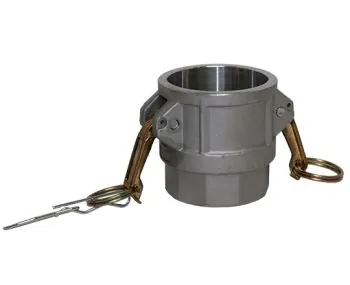
Aluminum — most widely used, light and economical for water and general transfer.
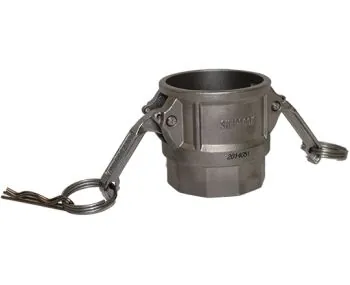
Stainless 304/316 — corrosion resistance for food, chemical and marine duty.
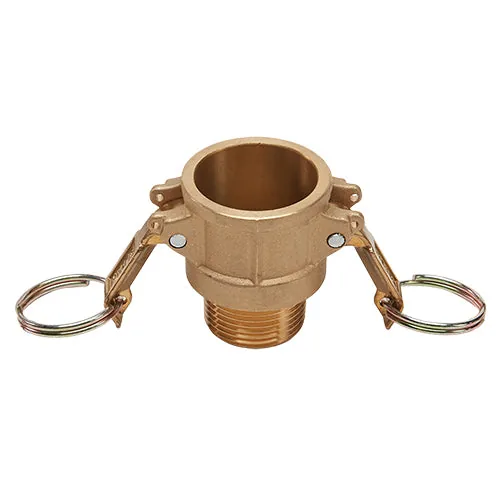
Brass — threaded strength and fuel/gas line service.
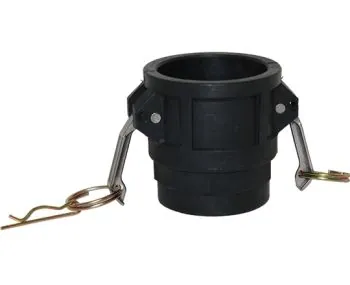
Polypropylene — chemical-resistant plastic at low pressure.
Camlock Materials at a Glance
| Material | Relative price | Relative weight | Best at | Weakest at |
|---|---|---|---|---|
| Cast aluminum | Low (~1/3 of stainless) | Light | Water, irrigation, fuels, general duty | Caustics, salt, acids |
| Stainless 304 | High (2.5–4x aluminum) | Heavy | Food, pharma, mild chemicals | Chlorides, brine |
| Stainless 316 | Highest (304 + 15–20%) | Heavy | Saltwater, marine, aggressive chemicals | Price |
| Brass | Medium (between Al and SS) | Medium | Fuels, precision threads, spark-safe areas | Aggressive water, dezincification |
| Polypropylene | Lowest of all four | Lightest of all four | Acids, solvents, DI water | Heat, pressure, hydrocarbons |
Aluminum: The Workhorse Default
Cast aluminum is the default camlock material for a simple reason: roughly 60% of all camlocks sold are aluminum, and it earns that share on the three things buyers care about first — price, weight, and adequate strength.
Strength. Cast aluminum camlocks are made from 356- or 360-series casting alloy, with typical ultimate tensile strength in the 30–40 ksi range. That is more than enough for the pressure ratings the fittings carry, and the failure mode is ductile rather than brittle. What aluminum lacks is not strength but hardness — it nicks and dents in rough yard service, and the handle on an abused coupling will eventually wear.
Corrosion resistance. Aluminum protects itself with a thin, self-healing oxide film. In neutral pH water (roughly pH 4–9) and dry air that film makes aluminum genuinely durable — which is why irrigation systems and truck tanks run it for decades. The film breaks down in two environments: strongly alkaline fluids (pH above ~9, such as caustic soda solutions, many detergents, and ammonia-based fertilizers) and chloride-rich atmospheres. Coastal salt air attacks bare aluminum couplers visibly, and chlorinated or brackish water accelerates pitting. If the coupling lives outdoors within a few kilometers of the sea, treat aluminum as a maintenance item or step up to 316.
Temperature limits. Aluminum camlocks are rated for service up to roughly 250°F with standard gaskets, and the metal itself stays mechanically sound well beyond that — the gasket, not the aluminum, is normally the limiting part. The practical issue at temperature is the differential expansion of the handle and the locking arms; do not expect rated pressure at the top of the temperature range (see the derating section below).
Pressure ratings. The industry-standard ratings for cast aluminum camlocks are size-dependent: 250 psi at ¾”–2”, 150 psi at ½”, 125 psi at 3”, 100 psi at 4”, and 75 psi at 5”–6”. These are cold-service ratings; reduce them as temperature rises.
Price. Aluminum runs about one-third the price of stainless steel and is the cheapest metal option on this list. For volume buyers the savings across a fleet of couplers are large enough to justify derating engineering time on non-corrosive service.
Applicable media. Water, irrigation and slurry lines, diesel and gasoline (with an NBR gasket), lube oil, hydraulic return lines, dry bulk powders, and mild aqueous chemicals. Avoid strong caustics, concentrated acids, saltwater, and anything food-contact. Aluminum is not rated for direct food contact, so food plants must use stainless — see our food grade guide.
Typical applications. Agricultural irrigation manifolds, municipal water trucks, fire-fighting hookups, oil and gas transfer hoses, dry-bulk pneumatic lines, and general workshop air/water duty.
Stainless Steel 304: The Clean-Service Standard
When the fluid is food, beverage, pharmaceutical, or anything a regulator will look at, stainless steel is the default — and 304 is the entry point.
Strength. Stainless 304 camlocks are investment-cast (CF8 grade) or forged, with minimum tensile strength around 75 ksi — roughly double cast aluminum. The material is also far harder, so threads, locking grooves, and gasket seats survive repeated coupling and uncoupling cycles without galling or wear. This is why stainless couplers stay tight for years in daily production use where aluminum would loosen.
Corrosion resistance. The 18% chromium / 8% nickel (“18-8”) chemistry gives 304 excellent resistance to water, food acids, mild chemicals, and atmospheric corrosion. It does not rust in the conventional sense, though chlorides are its blind spot: in brine, seawater, or chlorine-based sanitizers, 304 can pit — sometimes rapidly once pitting starts. If your water analysis shows chlorides above roughly 200 ppm in hot service, or you are on a coastline, 304 is the wrong grade and 316 is the right one.
Temperature limits. Stainless carries the widest safe temperature envelope of any camlock body material. With a PTFE gasket, 304 can serve lines well above 400°F; with EPDM the practical ceiling is around 250°F, and with Viton around 400°F. For steam and hot-line service, stainless is effectively the only serious choice among the four — see our pressure rating chart for how ratings behave at temperature.
Pressure ratings. Standard stainless camlocks share the same nominal rating family as aluminum — 250 psi at ¾”–2” — but with more margin behind it, because the higher-strength body derates more gracefully. Exact ratings vary by manufacturer and size, and 316-specific figures are given below.
Price. Expect 2.5–4x the price of aluminum, depending on size and finish. The premium buys corrosion-free service life, cleanability, and certification-friendliness — for a food plant the alternative (replacing corroded fittings or failing an audit) is far more expensive.
Applicable media. Potable water, food and dairy products, beverages, beer and wine lines, cosmetics, pharmaceuticals, CIP cleaning solutions (with care on chloride-based sanitizers), steam, and mild chemical solutions.
Typical applications. Dairy and brewery process lines, food-processing washdown stations, pharmaceutical water systems, potable water tankers, and any plant where white-glove hygiene inspection is routine.
Stainless Steel 316: The Marine and Chemical Upgrade
316 is 304 with one decisive addition: 2–3% molybdenum, plus a higher nickel content. That small alloying change transforms the alloy’s resistance to chloride pitting, salt, and reducing acids, and it is the single most common upgrade specified on camlocks.
Strength. 316 (cast as CF8M) has essentially the same mechanical strength as 304 — minimum tensile around 70–75 ksi — and the same hardness and wear characteristics. The strength story is identical; the corrosion story is what you are paying for.
Corrosion resistance. The molybdenum content stabilizes the passive oxide film in the presence of chlorides. In seawater, brackish water, chlorine sanitizers, brine, and salt spray, 316 resists the pitting and crevice corrosion that eventually destroy 304. It also stands up to a wider range of acids — dilute sulfuric acid, phosphoric acid, most organic acids — and to marine atmospheres that would pit both aluminum and 304 within months. For hot chloride service, 316 is not a luxury; it is the minimum viable material.
Temperature limits. Identical envelope to 304: the gasket sets the ceiling, and with high-temperature gaskets 316 serves steam and hot chemical lines comfortably above 400°F.
Pressure ratings. The commonly published 316 ratings are size-stepped exactly as follows: ½” at 150 psi, ¾”–2” at 250 psi, 2½” at 225 psi, 3” at 200 psi, 4” at 100 psi, and 5”–6” at 100 psi. Note the step down at 4” — larger-bore couplings spread load over larger sealing areas and are rated more conservatively across all materials.
Price. 316 typically costs 15–20% more than 304 and roughly 3–4.5x aluminum. Buyers should do that arithmetic against the cost of a marine line failure: a single seized or pitted stainless fitting can cost more than the price difference across an entire order.
Applicable media. Seawater, brine, salt spray, chlorine and hypochlorite sanitizers, citric and phosphoric acids, food and dairy (316 is the preferred grade for aggressive food acids), pharmaceutical clean steam, and general chemical transfer. For a deeper look at pump-and-hose chemical service, see our chemical transfer guide.
Typical applications. Offshore and dockside hose systems, boat fuel and water fittings, desalination plants, coastal food plants, breweries using chloride sanitizers, and chemical plants where 304 has already failed once.
Brass: The Fuel-Line Specialist
Brass occupies a smaller but stubborn share of the market, and almost all of it is fuel service. It is the material people reach for when the fluid is flammable and the threads need to be perfect.
Strength. Brass camlocks are machined from bar stock rather than cast, which changes the mechanical story in two ways: threads are cut, not formed, so they are sharper and hold thread-sealant and adapters more reliably; and tolerances are tighter, so the coupling engages with less slop. Tensile strength of common brass alloys (C36000 and similar) is around 45–55 ksi — between aluminum and stainless. Brass is also one of the few camlock materials that is effectively non-sparking, which is why safety officers specify it where aluminum-to-steel impact could throw a spark.
Corrosion resistance. Brass handles neutral water, fuels, oils, and dry environments well. Its known failure mode is dezincification: in soft, aggressive, or slightly acidic water, zinc leaches out of the alloy leaving weak, porous, copper-colored material that crumbles. Dezincification-resistant (DZR) brass alloys mitigate this, but for permanently wet potable or aggressive water, stainless is the more defensible choice. Brass also tarnishes and can develop green patina in humid marine air — cosmetic, but a signal that the material is not ideal there.
Temperature limits. Brass is comfortable from about -20°F up to roughly 250–300°F with appropriate gaskets. Above that, the alloy anneals and loses strength. For hot fuel or hot lube lines, verify the gasket rating rather than assuming the brass.
Pressure ratings. Brass generally carries the same nominal pressure family as aluminum — about 250 psi at ¾”–2” — thanks to machined construction and good thread engagement. Exact ratings vary by brand; confirm against the pressure rating chart.
Price. Between aluminum and stainless — typically 1.5–2.5x aluminum. The premium over aluminum buys spark safety, machined threads, and fuel compatibility that cast aluminum cannot fully match in safety-critical areas.
Applicable media. Diesel, gasoline, kerosene, jet fuel, lube oil, hydraulic oil, and other petroleum products — always with an NBR (Buna-N) gasket. Brass is also traditional for potable water fittings in many regions (modern lead-free brass where local codes require it).
Typical applications. Fuel depot transfer arms, diesel generator day tanks, fuel bowsers, marine fuel fills, hydraulic oil fill lines, and any classified area where spark risk is on the permit-to-work form.
Polypropylene: The Chemical Specialist
Polypropylene is the outsider of the four: not a metal at all, and yet the correct answer for a surprisingly large share of chemical transfer problems. It is also, for the record, the cheapest and the lightest material in this comparison — roughly half the weight of aluminum.
Strength. PP camlocks have tensile strength in the 4–6 ksi range — an order of magnitude below the metals — which is why their pressure ratings are the lowest of the four. What PP lacks in strength it makes up in a property no metal has: it is essentially chemically inert to a huge range of corrosive fluids.
Corrosion resistance. PP ignores most acids, alkalis, salt solutions, and solvents that would destroy every metal on this list. Dilute and many concentrated acids, caustic solutions, bleach at moderate temperatures, plating baths, and deionized water all pass through PP with no corrosion whatsoever — and because it is a plastic, there is no galvanic reaction with anything. The weak spots are: strong oxidizing acids (concentrated sulfuric and nitric acid attack it), aromatic and chlorinated hydrocarbons (benzene, toluene, gasoline — which swell PP), and UV light, which degrades unprotected polypropylene outdoors over a few years.
Temperature limits. This is the hard constraint: PP camlocks are rated to a maximum working temperature of 158°F (70°C), and the rating drops well before that as pressure rises. Above 158°F the plastic softens, the locking arms lose their spring, and the coupling can distort under load. Hot chemical lines belong to stainless with PTFE gaskets, not PP.
Pressure ratings. The standard PP ratings are the most conservative of the four: ½” at 75 psi, ¾”–2” at 100 psi, and 3” at 50 psi. Larger PP sizes are rarely rated for pressurized service at all — in 4” and above, PP camlocks are typically used for gravity drain or low-pressure transfer only.
Price. Lowest of the four materials, and the weight savings compound the savings: lighter fittings cut freight cost, and one person can handle sizes that would need two with steel.
Applicable media. Acids and alkalis (within concentration and temperature limits), plating chemicals, deionized and RO water, wastewater, brine, photographic chemicals, and aggressive solvents where the gasket (Viton or PTFE) is compatible. See our chemical transfer guide for gasket pairing rules on corrosive lines.
Typical applications. Electroplating lines, chemical dosing stations, DI water loops, laboratory and pharmaceutical waste lines, tanker off-loading of acids, and any system where metal ions in the fluid are unacceptable.
304 vs 316: The Deep Comparison
The most common specification debate on camlocks is 304 versus 316, and the honest answer is: the difference is not in strength, pressure, or temperature — it is entirely in chloride resistance. Here is the full picture.
| Property | 304 | 316 |
|---|---|---|
| Chromium | ~18% | ~16–18% |
| Nickel | ~8% | ~10–14% |
| Molybdenum | None | 2–3% |
| Tensile strength | ~75 ksi | ~70–75 ksi |
| Seawater / brine resistance | Pits over time | Resists pitting |
| Chlorine sanitizer resistance | Marginal | Good |
| Dilute acid resistance | Fair | Good |
| Price | Baseline | +15–20% |
| Food / dairy use | Yes | Yes (preferred for acid foods) |
| Pharmaceutical | Yes | Yes |
The molybdenum is the entire story. In fresh water, both grades are effectively immortal. In seawater, 304 will typically begin to show pitting within months to a couple of years depending on temperature and flow; 316 is designed to live in that environment for decades. In food plants using chlorine-based sanitizers — which almost all of them do — 304 can suffer pitting at weld seams and crevices over years of daily CIP cycles, which is why many dairies and breweries now spec 316 as standard.
The pricing logic is simple: if your water analysis or process sheet shows chlorides, salt, or marine exposure, pay the 15–20% premium and stop thinking about it. If the line is fresh water, food without aggressive sanitizers, or mild chemicals, 304 delivers the same service life for less money. For a size-by-size confirmation of ratings, check the pressure rating chart.
Material Selection Decision Table
The fastest way to spec a camlock: find your fluid, take the material and gasket row, and verify the temperature against the limits above.
| Fluid / service | Body material | Gasket | Notes |
|---|---|---|---|
| Fresh water, irrigation, slurry | Aluminum | EPDM | Default; cheap and light |
| Potable water | 304/316 or lead-free brass | EPDM | Check local drinking-water code |
| Diesel, gasoline, lube oil | Brass or aluminum | NBR | Brass where spark risk is controlled |
| Food, dairy, beverage | 304/316 | Food-grade EPDM | 316 if chlorine sanitizers are used |
| Beer, wine, juice | 316 | EPDM | Acidic products; frequent CIP |
| Saltwater, marine washdown | 316 | EPDM | Molybdenum is mandatory |
| Seawater continuous immersion | 316 | EPDM/Viton | Never aluminum or 304 |
| Dilute acids | PP or 316 | Viton/PTFE | PP for low pressure, 316 for hot |
| Concentrated acids | 316 | PTFE | Verify compatibility tables |
| Caustic soda (dilute) | PP | EPDM | Aluminum fails in caustics |
| Deionized / RO water | PP | EPDM | No metal ions leached |
| Solvents, aromatics | 316 | PTFE/Viton | PP swells in aromatics |
| Steam / hot water >200°F | 316 | Viton/PTFE | Derate pressure |
| Hydraulic oil | Aluminum or brass | NBR | — |
| Wastewater, brine | 316 or PP | EPDM/Viton | By temperature and pressure |
Mixing Materials: Galvanic Corrosion Warning
Physically, camlocks of different materials mate perfectly — the profile is standardized. The danger is electrochemical. When two dissimilar metals are joined in a wet line, the more active (less noble) metal becomes the anode of a galvanic cell and corrodes — often invisibly, from the inside, until the fitting fails.
The classic pairings to avoid in wet service:
- Aluminum coupling on stainless adapters or hose tails — aluminum corrodes fast, usually right at the contact line. This is the most common mistake in the field, because stainless piping is everywhere and aluminum couplers are cheap.
- Brass on aluminum — aluminum loses again.
- Stainless on aluminum or brass in saltwater — the saltwater electrolyte makes the galvanic couple far more aggressive; damage that took a year in fresh water can happen in weeks.
The rule is simple: keep both halves of a wet connection in the same material family. Aluminum to aluminum, stainless to stainless, brass to brass. In dry or intermittent service — a coupling that connects for a transfer and is disconnected and drained afterward — mixed metals are a manageable risk, but in a permanently plumbed wet line they are a defect. If your system forces a transition between material families (for example, stainless pipe to an aluminum hose), put a dielectric isolation or an appropriate adapter between them and inspect the joint on a schedule.
A second mixing hazard has nothing to do with galvanics: gaskets and seals from different suppliers are not interchangeable, and a “matching” coupling pair with mismatched gaskets can leak at rated pressure. Always confirm the gasket compound on both halves — never assume.
Industry-by-Industry Selection
Chemical processing. The default pair is 316 bodies with Viton or PTFE gaskets for hot or aggressive service, and PP bodies for ambient-temperature acid and alkali duty. Never use aluminum where caustic soda, ammonia, or chloride-bearing process streams are present. For solvent service, verify gasket swell data — Viton handles most aromatics, PTFE handles nearly everything. Chemical transfer has the full pairing matrix.
Food, dairy, and beverage. Stainless 304 or 316 with food-grade EPDM gaskets is the industry norm, and the plant’s sanitary standard will decide which grade. Plants running chlorine-based CIP sanitizers increasingly standardize on 316. The surface finish matters too — specify a smooth internal finish so the fitting drains and cleans without harboring bacteria. Our food grade guide covers FDA and 3-A considerations in detail.
Marine and coastal. 316, exclusively, for anything that touches seawater or lives in salt air. Aluminum pitting and brass dezincification both show up on boats and docks, and 304 is a false economy once chloride is in the picture. Add a Viton gasket where fuel and water both pass through the same hose system, and rinse fittings with fresh water after salt exposure as cheap insurance.
Agriculture and irrigation. Aluminum with EPDM is the economic winner for water, slurry, and fertilizer transfer — with one warning: many liquid fertilizers are ammonium- or urea-based and run alkaline, which attacks aluminum. If your fertilizer program is caustic, step up to PP or stainless. For potable livestock water, use stainless or lead-free brass.
Fuel and petroleum. Brass with NBR is the traditional spec for diesel and gasoline, prized for machined threads and spark safety. Aluminum with NBR is an acceptable and cheaper alternative outside classified areas. Do not use PP for petroleum products — hydrocarbons swell polypropylene. For avgas and jet fuel, follow the site’s explosion-safety rules and confirm the gasket compound with the supplier.
Coatings and Surface Treatments
Material choice is not the end of the story — surface treatment changes how long a fitting lasts in specific environments.
Anodizing (aluminum). Type II anodizing grows a hard, corrosion-resistant oxide layer into the surface of aluminum camlocks, available clear or dyed (black, blue, red are common for color-coding lines). It materially slows atmospheric corrosion and makes the fitting easier to clean. Two caveats: anodizing is thin and scratches at the locking arms and gasket seat reveal bare aluminum underneath, so an anodized fitting in constant saltwater still corrodes at wear points; and anodizing does not change the galvanic position of aluminum — it is still the anode against stainless. Type III hardcoat anodizing is much thicker and used for heavy-wear service, at higher cost.
Electroplating (steel and brass). Carbon-steel camlocks — a minority of the market, but present in fire and general industrial lines — are almost always zinc-plated or epoxy-coated for corrosion protection. Brass fittings are sometimes nickel-plated to prevent tarnishing and dezincification in humid service. Remember that plating is a sacrificial layer: once it wears through at thread contact points, the base metal corrodes at the scratch.
Powder coating and epoxy (aluminum and steel). Thick polymer coatings give aluminum fittings a corrosion barrier for outdoor and chemical-fume environments, and are common on fire-service couplers that must stay red and identifiable. Coating thickness protects better than anodizing but chips on impact; inspect coated fittings for damage at the handle and lug areas.
Passivation (stainless). Stainless camlocks benefit from acid passivation after fabrication, which removes free iron from the surface and lets the chromium oxide film form fully. Ask your supplier whether fittings are passivated — it is a small detail with a real effect on early corrosion in chloride service.
Temperature and Pressure Derating
Every pressure rating in this guide is a cold-service rating. Real working pressure falls as temperature rises, and the rate of fall depends on the material:
- Polypropylene derates fastest. The 158°F ceiling is absolute, and usable pressure at 140°F is already well below the 100 psi cold rating. Above 158°F PP is not a pressure material at all.
- Aluminum holds its rating to roughly 120–150°F, then derates gradually; at 250°F expect a meaningful reduction, and above that the gasket — usually EPDM at ~250°F — becomes the hard stop.
- Brass behaves like aluminum: fine to about 250°F, then annealing softens the alloy and ratings must come down.
- Stainless (304/316) derates least: the metal is good well past 400°F, and in practice the gasket sets the ceiling (EPDM ~250°F, Viton ~400°F, PTFE ~450°F+). For steam service, use stainless bodies with Viton or PTFE and consult the pressure rating chart for the derated figures.
Two operational derates that have nothing to do with temperature: surge pressure (a valve slamming shut can momentarily double line pressure — spec the coupling above the surge, not the steady state) and vacuum (camlock profiles are not vacuum-rated; a collapsing hose or pump suction can pull the gasket out of its seat).
FAQ
Can I connect camlocks of different materials together? Physically yes — the profile is standardized across materials. In wet service, avoid it: galvanic corrosion eats the less noble metal (aluminum loses against both stainless and brass). Same material family on both halves is the rule; mixed metals only in dry or drained intermittent service.
Is aluminum food-safe? No, not for direct food contact. Food, dairy, and beverage duty means stainless steel (304/316) with food-grade gaskets. See the food grade guide for the full compliance picture.
Which material lasts longest in seawater? 316 stainless, decisively. Aluminum pits, brass dezincifies, 304 pits in chloride service, and PP lacks the strength for pressurized marine lines. The 2–3% molybdenum in 316 is precisely what makes it the marine standard.
Why does PP cost so little — is it a compromise? PP is the cheapest and lightest of the four materials, and that is exactly right for its job: ambient-temperature acid, alkali, and DI water service at low pressure. Its limits are heat (158°F max) and pressure (100 psi at ¾”–2”). It is not a downgrade — it is a specialist.
When is 316 worth the extra 15–20% over 304? Any time chlorides are in the fluid or the atmosphere: seawater, brine, chlorine sanitizers, coastal plants, road-salt environments. In fresh-water-only service, 304 gives the same life for less money.
Is brass still allowed for potable water? In many regions, yes — with lead-free brass where codes require it. Check the local drinking-water standard; stainless or certified plastics are increasingly preferred for potable contact.
Can I use PP for diesel or gasoline? No. Aromatic and aliphatic hydrocarbons swell polypropylene, which loses strength and seal integrity. Fuels belong to brass or aluminum with NBR gaskets.
How do I know the exact rating for my size and material? The figures above are standard industry values; verify the exact rating for your size, material, and gasket with the pressure rating chart and confirm with your supplier before specification.
Material performance data are reference values from public industry sources, pending factory verification. Confirm compatibility with your exact fluid, temperature, and pressure before specification.
Get the Right Material the First Time
The wrong material fails quietly, on a schedule you do not control — in a food line, a fuel depot, or a marine dock, the cost of that failure is never just the price of the coupling. Send us your fluid, temperature, pressure, and size, and CamlockPro will confirm the body material and gasket combination before you order. Volume pricing is available on aluminum and PP; 316 and brass ship from stock in standard sizes.
Browse camlock coupling types · Pressure rating chart · Gasket selection · Food grade · Chemical transfer