
Camlock Couplings for Water Lines: Sizing, Pressure and Potable Duty
Water is the most common camlock duty in the world — construction site dewatering, pump testing, municipal bypass lines, tanker filling, washdown rigs and temporary fire protection supply. Camlocks dominate because they connect in seconds, seal reliably at working pressure and come in every size from ½” to 6”. Here is how to spec camlocks for water service, including potable (drinking) water where the rules get stricter.
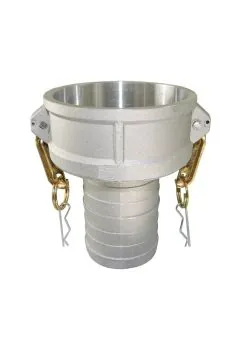
Type C on the water hose; size and pressure decide the coupling.
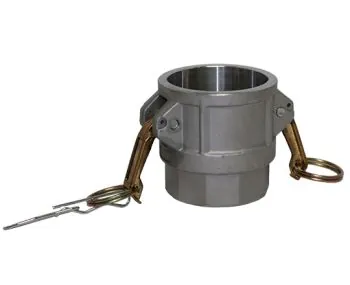
Type D on the pipe side of site water connections.
Material by water duty
| Duty | Material | Notes |
|---|---|---|
| General water (dewatering, washdown, pump discharge) | Aluminum | The standard: light, cheap, corrosion-resistant in clean water |
| Potable / drinking water | Polypropylene or stainless | PP is chemically inert and a common potable choice; stainless where pressure or durability demands metal |
| Salt water / brackish | Stainless (316) | Aluminum pits fast in salt water; 316 is the conservative marine choice |
| Permanent buried or fixed lines | Stainless | No UV degradation, long service life |
| Chemical-treated water (chlorine dosing, cooling towers) | PP or stainless | Check compatibility with the treatment chemical |
Gaskets: EPDM is the water default
- EPDM — the standard water gasket; excellent in clean water, ozone and weather resistance, long service life
- Potable-water EPDM — use gaskets certified for drinking-water contact (NSF/ANSI 61 or equivalent) on potable lines
- NBR — not for plain water; it is the fuel/oil gasket
- Viton/PTFE — only for aggressive chemical water treatment
On water rigs, a spare EPDM gasket with the pump is the cheapest insurance on the job site.
Sizing by flow, not pressure
Water mains and transfer lines run 30-150 psi. Reference working pressures from the standard camlock table are far above that (2” aluminum ≈ 200 psi, 3” ≈ 150 psi at the top end of the size range), so size water camlocks by flow rate:
- 1” — washdown, small pumps (up to ~40 gpm)
- 1½” — dewatering, medium pumps (~40-80 gpm)
- 2” — standard transfer and pump discharge (up to ~150 gpm)
- 3” — high-flow transfer, tanker fill (~150-300 gpm)
- 4”-6” — bulk transfer, large pump stations, emergency water supply
Match the coupling to the hose bore, not the pump outlet thread.
Typical water layouts
- Pump to hose: Type A (male NPT) at the pump outlet → Type C (male hose shank) into the hose
- Hose to tank/header: Type D (female hose shank) on the tank or header connection
- Layflat lines: Type E (male hose shank, offset) where the hose lies flat and a straight shank kinks
- Hydrant/tanker fill: 3”-4” aluminum, A + C, with a dust cap on the open end when idle
Potable water notes
- Use PP or stainless bodies and NSF-certified EPDM gaskets
- Do not reuse gaskets from non-potable duty on drinking-water lines
- Cap open ends: a dirty groove on a potable line is a contamination point, not just a leak source
- Keep potable gear separate from dewatering gear on mixed-use sites — color-coded handles help crews keep them apart
Field checklist
- Close both arms fully — half-closed arms on a 100 psi line blow off under load
- Support long hose runs — the coupling should not carry hose weight or act as a hinge
- Dust caps on idle ends — grit in the groove is the #1 cause of water-line leaks
- Rinse after dirty duty — mud and silt accelerate gasket wear; rinse before storage
- Annual gasket swap on permanent water connections
Checklist for a water order
- Sizes: match hose bore (1”, 1½”, 2”, 3”, 4”, 6”)
- Types: A + C (pump to hose), D (tank/header), E (layflat)
- Material: aluminum (general), PP (potable), 316 stainless (salt/permanent)
- Gasket: EPDM, NSF-certified for potable lines
- Extras: dust caps and plugs, spare gaskets, anodized finish for permanent installs
Send us your flow rate, hose sizes and whether the line is potable and we will confirm the coupling set.
Related guides
- Camlock size chart — measuring the hose bore correctly
- Camlock pressure rating chart — working pressures by material and size
- Camlock gasket selection — EPDM for water, NBR for fuel, Viton for chemicals
- Camlock couplings for irrigation — the ag water companion guide